The resistance of $1\, A$ ammeter is $0.018\,\Omega $. To convert it into $10\, A$ ammeter, the shunt resistance required will be
Easy
Download our app for free and get started
$S = \frac{{{i_g}G}}{{(i - {i_g})}}$$ = \frac{{1 \times 0.018}}{{10 - 1}} = \frac{{0.018}}{9} = 0.002\,\Omega $

Download our appand get started for free
Experience the future of education. Simply download our apps or reach out to us for more information. Let's shape the future of learning together!No signup needed.*
Similar Questions
- 1A proton and an $\alpha - $particle enter a uniform magnetic field perpendicularly with the same speed. If proton takes $25$ $\mu \, sec$ to make $5$ revolutions, then the periodic time for the $\alpha - $ particle would be........$\mu \, sec$View Solution
- 2A long straight wire of radius $a$ carries a steady current $I.$ The current is uniformly distributed over its cross-section. The ratio of the magnetic fields $B$ and $B',$ at radial distances $\frac{a}{2}$ and $2a$ respectively, from the axis of the wire isView Solution
- 3Two ions having same mass have charges in the ratio $1: 2$. They are projected normally in a uniform magnetic field with their speeds in the ratio $2: 3$. The ratio of the radii of their circular trajectories is -View Solution
- 4A proton and an $\alpha -$ particle (with their masses in the ratio of $1 : 4$ and charges in the ratio of $1:2$ are accelerated from rest through a potential difference $V$. If a uniform magnetic field $(B)$ is set up perpendicular to their velocities, the ratio of the radii $r_p : r_{\alpha }$ of the circular paths described by them will beView Solution
- 5A square shaped wire loop of mass $m$, resistance $R$ and side $a$ moving speed $v_{0}$, parallel to the $X$-axis, enters a region of uniform magnetic field $B$, which is perpendicular to the plane of the loop. The speed of the loop changes with distance $x(x < a)$ in the field, asView Solution
- 6The strength of the magnetic field at a point $r$ near a long straight current carrying wire is $B$. The field at a distance $\frac{r}{2}$ will beView Solution
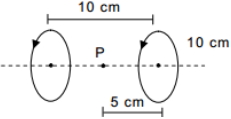
- 7Two circular loops having same radius $[ R =10\, cm ]$ and same current $\frac{7}{2} A$ are placed along same axis as shown. If distance between their centre is $10\, cm$, find net magnetic field at of point $P.$View Solution
- 8A one metre long wire is lying at right angles to the magnetic field. A force of $1\, kg$ wt. is acting on it in a magnetic field of $0.98\, Tesla$. The current flowing in it will be....$A$View Solution
- 9A magnetised wire of moment $M$ is bent into an arc of a circle subtending an angle of $60^o$ at the centre; then the new magnetic moment isView Solution
- 10An electron moving with a uniform velocity along the positive $x$-direction enters a magnetic field directed along the positive $y$-direction. The force on the electron is directed alongView Solution