The resistance of a wire of uniform diameter $d$ and length $L$ is $R$. The resistance of another wire of the same material but diameter $2d$ and length $4L$ will be
Easy
Download our app for free and get started
(b) $R \propto \frac{l}{A} \propto \frac{l}{{{d^2}}}$ $\Rightarrow $ $\frac{{{R_1}}}{{{R_2}}} = \frac{{{l_1}}}{{{l_2}}} \times \,{\left( {\frac{{{d_2}}}{{{d_1}}}} \right)^2} = \frac{L}{{4L}}\,{\left( {\frac{{2d}}{d}} \right)^2} = 1$
$\Rightarrow $ $R_2 = R_1 = R.$

Download our appand get started for free
Experience the future of education. Simply download our apps or reach out to us for more information. Let's shape the future of learning together!No signup needed.*
Similar Questions
- 1View SolutionThe resistance of an incandescent lamp is
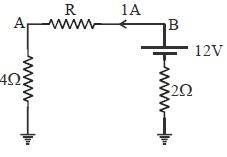
- 2View SolutionIn the circuit shown in the figure below, which of the following statement is incorrect ?
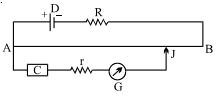
- 3In the given potentiometer circuit, the resistance of the potentiometer wire $AB$ is $R_0$. $C$ is a cell of internal resistance $r$. The galvanometer $G$ does not give zero deflection for any position of the jockey $J$. Which of the following cannot be a reason for this?View Solution
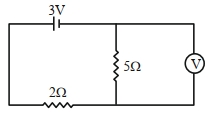
- 4As shown in the figure, the voltmeter reads $2\,V$ across $5\,\Omega$ resistor. The resistance of the voltmeter is $.......\,\Omega$.View Solution
- 5The length of a given cylindrical wire is increased to double of its original length. The percentage increase in the resistance of the wire will be..... $\%$.View Solution
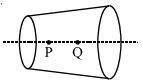
- 6A wire has a non-uniform cross-section as shown in figure.A steady current flows through it. The drift speed of electrons at points $P$ and $q$ is $v_P$ and $v_Q$.View Solution
- 7Two electric bulbs, rated at $(25\, W, 220\, V)$ and $(100\, W, 220\, V)$, are connected in series acroos a $220\, V$ voltage source. If the $25\, W$ and $100\, W$ bulbs draw powers $P_1$ and $P_2$ respectively, thenView Solution
- 8Two identical batteries, each of $e.m.f.$ $2\, volt$ and internal resistance $1.0\, ohm$ are available to produce heat in an external resistance $R = 0.5\,ohm$ by passing a current through it. The maximum Joulean power that can be developed across $R$ using these batteries is ............. $watt$View Solution
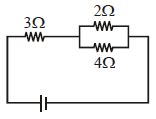
- 9If power in $3\,\Omega $ is $27\,W$ then what is the power in $2\,\Omega $ ................. $W$View Solution
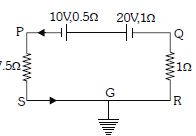
- 10View SolutionIn the given circuit