MCQ
The resistance of an ideal voltmeter is
  • A
    Zero
  • B
    Very low
  • C
    Very large
  • Infinite

Answer

Correct option: D.
Infinite
d
(d)The resistance of an ideal voltmeter is considered as infinite.

Need a full question paper?

Generate a complete, print-ready paper with questions like this in minutes — across 16+ boards, with answer keys.
Start Generating Free

Similar questions

If a source of power $4\,kW$ produces $10^{20}$ photons/second, the radiation belongs to a part of the spectrum called
The ratio of speed of sound in hydrogen gas to the speed of sound in oxygen gas at the same temperature is
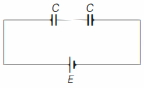
Two identical parallel plate capacitors of capacitance $C$ each are connected in series with a battery of emf, $E$ as shown below. If one of the capacitors is now filled with a dielectric of dielectric constant $k$, then the amount of charge which will flow through the battery is (neglect internal resistance of the battery)
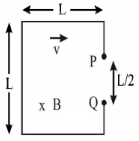
The loop shown moves with a velocity $v$ in a uniform magnetic field of magnitude B, directed into the paper. The potential difference between $P$ and $Q$ is e. Then :
A plane electromagnetic wave travelling along the $X$-direction has a wavelength of $3\ mm$ . The variation in the electric field occurs in the $Y$-direction with an amplitude $66\  Vm^{-1}$. The equations for the electric and magnetic fields as a function of $x$ and $t$ are respectively :-
At what height above the earth’s surface does the acceleration due to gravity fall to $1\%$ of its value at the earth’s surface ?
In the middle of the depletion layer of a reverse-biased $PN$ junction, the
The resistance of an ammeter is $13\, \Omega$ and its scale is graduated for a current upto $100$ $amps$. After an additional shunt has been connected to this ammeter it becomes possible to measure currents upto $750$ $ampere$ by this meter. The value of shunt-resistance is 
In $LCR$ circuit, the capacitance is changed from $C$ to $4C$. For the same resonant frequency, the inductance should be changed from $ L$ to
Electric charges having same magnitude of electricicharge $q$ coulombs are placed at $x=1 \,m , 2 \,m , 4 \,m$, $8 \,m$....... so on. If any two consecutive charges have opposite sign but the first charge is necessarily positive, what will be the potential at $x=0$ ?