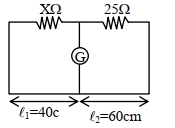
The resistance per centimeter of a meter bridge wire is $\mathrm{r}$, with $\mathrm{X}\ \Omega$ resistance in left gap. Balancing length from left end is at $40 \mathrm{~cm}$ with $25\ \Omega$ resistance in right gap. Now the wire is replaced by another wire of $2 \mathrm{r}$ resistance per centimeter. The new balancing length for same settings will be at
JEE MAIN 2024, Diffcult


Download our appand get started for free
Experience the future of education. Simply download our apps or reach out to us for more information. Let's shape the future of learning together!No signup needed.*
Similar Questions
- 1A potential $V_0$ is applied across a uniform wire of resistance $R$. The power dissipation is $P_1$. The wire is then cut into two equal halves and a potential of $V _0$ is applied across the length of each half. The total power dissipation across two wires is $P_2$. The ratio $P_2: P_1$ is $\sqrt{x}: 1$. The value of $x$ is $.............$.View Solution
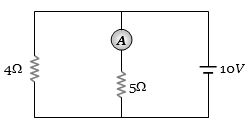
- 2In the circuit, the reading of the ammeter is ................. $A$ (assume internal resistance of the battery be zero)View Solution
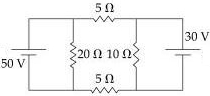
- 3In the circuit shown, current (in $A$) through $50\; V$ and $30\; V$ batteries are, respectivelyView Solution
- 4Current density in a cylindrical wire of radius $R$ is given as $J =$ $\left\{ {\begin{array}{*{20}{c}}View Solution
{{J_0}\left( {\frac{x}{R} - 1} \right)\,\,for\,\,0 \leqslant x < \frac{R}{2}} \\
{{J_0}\frac{x}{R}\,\,\,\,for\,\,\,\frac{R}{2} \leqslant x \leqslant R}
\end{array}} \right.$The current flowing in the wire is: - 5Two wires of same metal have the same length but their cross-sections are in the ratio $3:1$. They are joined in series. The resistance of the thicker wire is $10\,\Omega $. The total resistance of the combination will be ............. $\Omega$View Solution
- 6Two cells of $e.m.f.$ $E_1$ and $E_2$ are joined in series and the balancing length of the potentiometer wire is $625$ $cm$. If the terminals of $E_1$ are reversed, the balancing length obtained is $125 \,cm$. Given $E_2 > E_1$, the ratio $E_1: E_2$ will beView Solution
- 7A battery having $e.m.f.$ $5\,\,V$ and internal resistance $0.5$ $\Omega$ is connected with a resistance of $4.5 \,\Omega$ then the voltage at the terminals of battery is ............. $V$View Solution
- 8The specific resistance of manganin is $50 \times {10^{ - 8}}\,ohm \times m$. The resistance of a cube of length $50\,cm$ will beView Solution
- 9Two bulbs consume same power when operated at $200\, V$ and $300\, V$ respectively. When these bulbs are connected in series across a $D.C$. source of $500\, V$, thenView Solution
- 10Potentiometer wire of length $1 \,m$ is connected in series with $490\,\Omega $ resistance and $2\,V$ battery. If $0.2\, mV/cm $ is the potential gradient, then resistance of the potentiometer wire is ................ $\Omega$View Solution