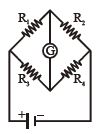
The resistances in $WSB$ circuit shown in the diagram all are different and the current through the galvanometer is zero. If all thermal effects are negligible, the current through the galvanometer will not be zero, when
Easy


Download our appand get started for free
Experience the future of education. Simply download our apps or reach out to us for more information. Let's shape the future of learning together!No signup needed.*
Similar Questions
- 1A potentiometer is an accurate and versatile device to make electrical measurements of $EMF$ because the method involvesView Solution
- 2When two identical batteries of internal resistance $1 \Omega$ each are connected in series across a resistor $\mathrm{R}$, the rate of heat produced in $R$ is $J_1$. When the same batteries are connected in parallel across $R$, the rate is $\mathrm{J}_2$. If $\mathrm{J}_1=2.25 \mathrm{~J}_2$ then the value of $\mathrm{R}$ in $\Omega$ isView Solution
- 3Resistances ${R_1}$ and ${R_2}$ are joined in parallel and a current is passed so that the amount of heat liberated is ${H_1}$ and ${H_2}$ respectively. The ratio $\frac{{{H_1}}}{{{H_2}}}$ has the valueView Solution
- 4A $50 \,W$ bulb connected in series with a heater coil is put to an $AC$ mains. Now the bulb is replaced by a $100 \,W$ bulb. The heater output will ...........View Solution
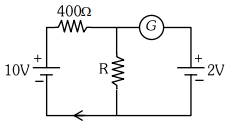
- 5If the galvanometer $G$ does not show any deflection in the circuit shown, the value of $R$ is given by $............\Omega$View Solution
- 6The power rating of an electric motor which draws a current of $3.75\, amperes$ when operated at $200\, V$ is aboutView Solution
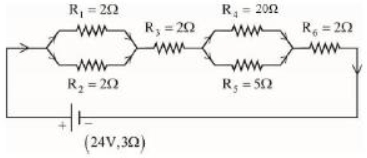
- 7As shown in the figure, a network of resistors is connected to a battery of $2\,V$ with an internal resistance of $3\,\Omega$. The currents through the resistors $R_4$ and $R_5$ are $I_4$ and $I_5$ respectively. The values of $I_4$ and $I_5$ are :View Solution
- 8Consider a wire having current $10\,A$ having area of crossection $1\,cm^2$. If number of electrons per unit volume is $9 \times 10^{28}\, m^{-3}$. Find the drift velocity of electronsView Solution
- 9A cylindrical copper rod has length $L$ and resistance $R$. If it is melted and formed into another rod of length $2 L$, then the resistance will be ....... $R$View Solution
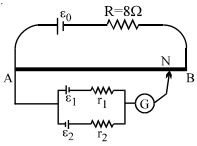
- 10$A$ battery of $\mathrm{emf}$ $E_0 = 12\, V$ is connected across a $4\,m$ long uniform wire having resistance $4\,\Omega /m$. The cells of small $\mathrm{emfs}$ $\varepsilon_1 = 2\,V$ and $\varepsilon_2 = 4\,V$ having internal resistance $2\Omega$ and $6\Omega$ respectively, are connected as shown in the figure. If galvanometer shows no deflection at the point $N$, the distance of point $N$ from the point $A$ is equal toView Solution