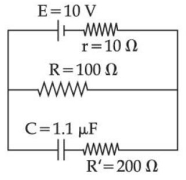
The resistivity of alloys $ = {R_{{\rm{alloy}}}}$; the resistivity of constituent metals ${R_{{\rm{metal}}}}$. Then, usually
Easy


Download our appand get started for free
Experience the future of education. Simply download our apps or reach out to us for more information. Let's shape the future of learning together!No signup needed.*
Similar Questions
- 1Three resistors of $4\,\Omega ,6\,\Omega $ and $12\,\Omega $ are connected in parallel and the combination is connected in series with a $1.5\, V$ battery of $1\,\Omega $ internal resistance. The rate of Joule heating in the $4\,\Omega $ resistor is ................ $W$View Solution
- 2$A$ total charge $Q$ flows across a resistor $R$ during a time interval $= T$ in such a way that the current vs. time graph for $0 \rightarrow T$ is like the loop of a sin curve in the range $0 \rightarrow \pi$ . The total heat generated in the resistor isView Solution
- 3Two cells when connected in series are balanced on $8\;m$ on a potentiometer. If the cells are connected with polarities of one of the cell is reversed, they balance on $2\,m$. The ratio of $e.m.f.$'s of the two cells isView Solution
- 4View SolutionIf a high power heater is connected to electric mains, then the bulbs in the house become dim, because there is a
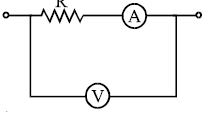
- 5In the circuit shown the resistance of voltmeter is $10,000\, ohm$ and that of ammeter is $20\,ohm$. The ammeter reading is $0.10\,Amp$ and voltmeter reading is $12$ $\mathrm{volt}.$ Then $R$ is equal to .............. $\Omega$View Solution
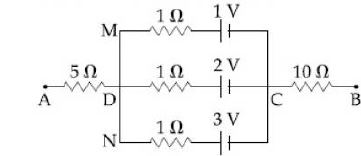
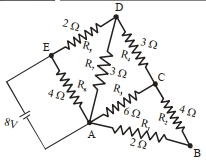
- 6In the circuit shown, the potential difference between $A$ and $B$ is ............. $V$View Solution
- 7The resistance of an electrical toaster has a temperature dependence given by $R\left( T \right) = {R_0}\left[ {1 + \alpha \left( {T - {T_0}} \right)} \right]$ in its range of operation. At ${T_0} = 300\,K,R = 100\,\Omega $ and at $T = 500\,K,\,R = 120\,\Omega $. The toaster is connected to a voltage source at $200\, V$ and its temperature is raised at a constant rate from $300$ to $500\, K$ in $30\, s$. The total work done in raising the temperature isView Solution
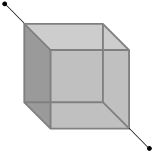
- 8Twelve wires of equal length and same cross-section are connected in the form of a cube. If the resistance of each of the wires is $R$, then the effective resistance between the two diagonal ends would beView Solution
- 9The current flowing through $R _2$ is:View Solution
- 10As show in the figure, in steady state, the charge stored in the capacitor is....... $\times 10^{-6}\,C$.View Solution