MCQ
The resolving power of a telescope depends on:
  • A
    Length of telescope
  • B
    Focal length of objective
  • Diameter of the objective
  • D
    Focal length of eyepiece

Answer

Correct option: C.
Diameter of the objective

Resolving power of telescope $\text{R}=\frac{1}{\Delta\theta}=\frac{\text{a}}{1.22\lambda}$
where, $\Delta\theta$ is angular separation between two objects.
a is the diameter of the objective.
$\lambda$ is wavelength of light.
So, clearly resolving power of a telescope depends on diameter of the objective.

Need a full question paper?

Generate a complete, print-ready paper with questions like this in minutes — across 16+ boards, with answer keys.
Start Generating Free

Similar questions

In a forward biased PN-junction diode, the potential barrier in the depletion region is of the form … 
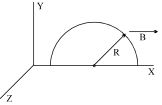
$A$ semicircle conducting ring of radius $R$ is placed in the $xy$ plane, as shown in the figure. $A$ uniform magnetic field is set up along the $x$ -axis. No $emf$, will be induced in the ring. if
A rod with circular cross-section area $2\,cm ^2$ and length $40\,cm$ is wound uniformly with $400$ turns of an insulated wire. If a current of $0.4\,A$ flows in the wire windings, the total magnetic flux produced inside windings is $4\,\pi \times 10^{-6}\,Wb$. The relative permeability of the rod is (Given : Permeability of  vacuum $\left.\mu_0=4 \pi \times 10^{-7} \;NA ^{-2}\right)$
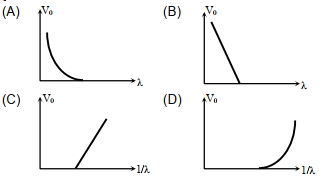
For photo-electric effect with incident photon wavelength $\lambda$, the stopping potential is $V _0$. Identify the correct variation$(s)$ of $V _0$ with $\lambda$ and $1 / \lambda$. $Image$
When a point source of light is at a distance of $50 \,cm$ from a photoelectric cell, the cut-off voltage is found to be $V_0$. If the same source is placed at a distance of $1 \,m$ from the cell, then the cut-off voltage will be
Assertion : In Young’s experiment, the fringe width for dark fringes is different from that for white fringes.
Reason : In Young’s double slit experiment the fringes are performed with a source of white light, then only black and bright fringes are observed.
Two identical particles of mass m carry a charge $Q$ each. Initially one is at rest on a smooth horizontal plane and the other is projected along the plane directly towards first particle from a large distance with speed $v.$ The closest distance of approach be 
Two sources of light of wavelengths $2500{\text{ }}\mathop {\text{A}}\limits^o $ and $3500{\text{ }}\mathop {\text{A}}\limits^o $ are used in Young’s double slit expt. simultaneously. Which orders of fringes of two wavelength patterns coincide ?
A double charged lithium atom is equivalent to hydrogen whose atomic number is 3. The wavelength of required radiation for emitting electron from first to third Bohr orbit in $Li^{++}$ will be (Ionisation energy of hydrogen atom is 13.6eV) 
A wire of length $10 \mathrm{~cm}$ and radius $\sqrt{7} \times 10^{-4} \mathrm{~m}$ connected across the right gap of a meter bridge. When a resistance of $4.5 \ \Omega$ is connected on the left gap by using a resistance box, the balance length is found to be at $60 \mathrm{~cm}$ from the left end. If the resistivity of the wire is $\mathrm{R} \times 10^{-7} \Omega \mathrm{m}$, then value of $\mathrm{R}$ is :