Question
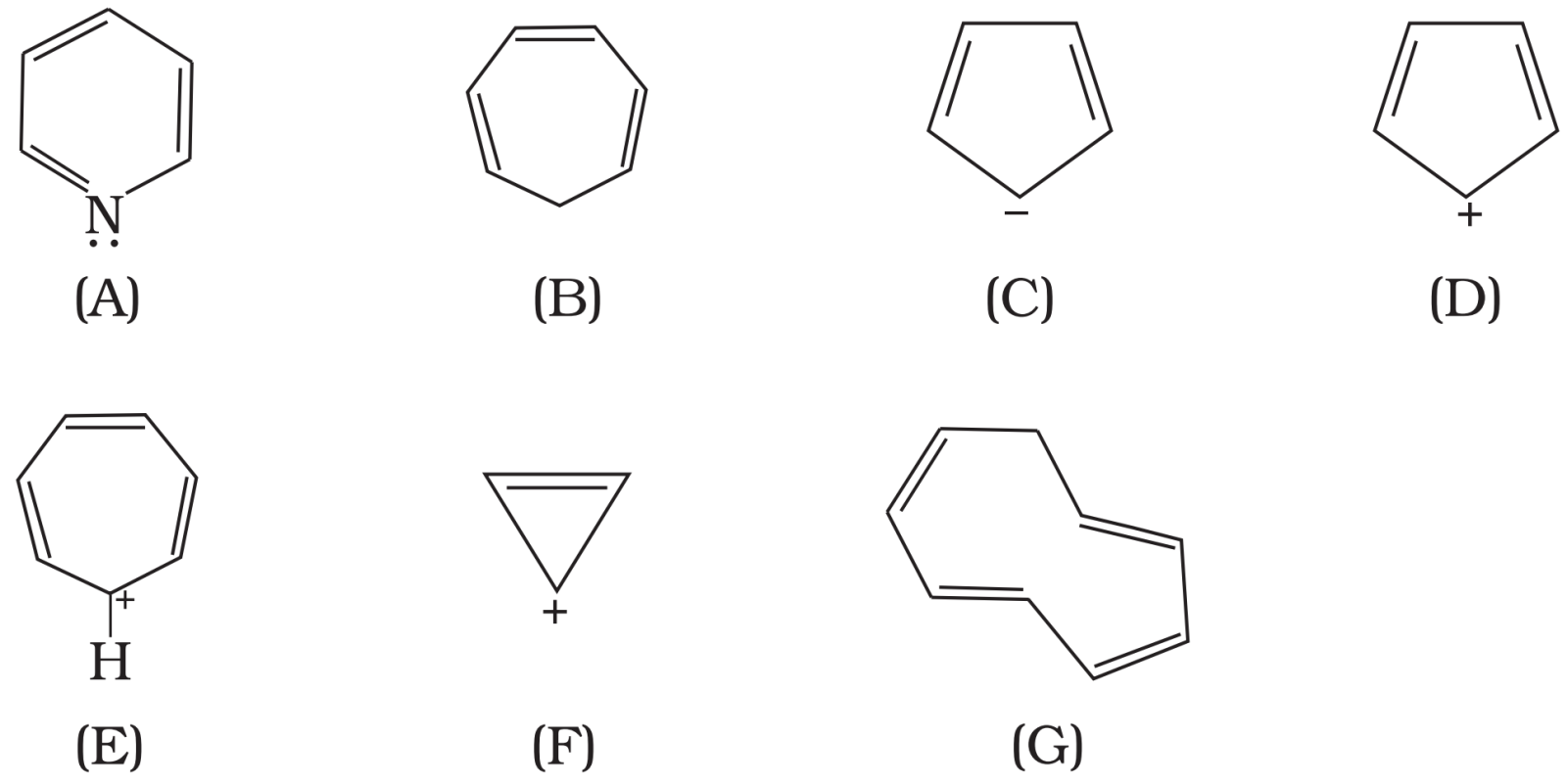
The ring systems having following characteristics are aromatic.
  1. Planar ring containing conjugated $\pi$ bonds.
  2. Complete delocalisation of the $\pi$−electrons in ring system i.e. each atom in the ring has unhybridised p-orbital, and
  3. Presence of (4n + 2)$\pi$−electrons in the ring where n is an integer (n = 0, 1, 2, ..........) [Huckel rule].
Using this information classify the following compounds as aromatic/ nonaromatic.

Answer

$\mathrm{A}=$ Planar ring, all atoms of the ring $\mathrm{sp}^2$ hybridised, has six delocalised $\pi$-electrons, follows Huckel rule. It is aromatic. $\mathrm{B}=$ Has six $\pi$-electrons, but the delocalisation stops at $\mathrm{sp}^3$ hybridised $\mathrm{CH}_2$ - carbon. Hence, not aromatic. C $=$ Six delocalised $\pi$-electrons ( $4 \pi$ electrons +2 unshared electrons on negatively charged carbon) in a planar ring, follows Huckel's rule. It is aromatic. $\mathrm{D}=$ Has only four delocalised $\pi$-electrons. It is non aromatic. $\mathrm{E}=$ Six delocalised $\pi$-electrons follows Huckel's rule. $\pi$-electrons are in $\mathrm{sp}^2$ hybridised orbitals, conjugation all over the ring because of positively charged carbon. The ring is planar hence is aromatic. F = Follows Huckel's rule, has $2 \pi$ electrons i.e. ( $4 \mathrm{n}+$ 2) $\pi$-electrons where $(n=0)$, delocalised $\pi$-electrons. It is aromatic. $G=8 \pi$ electrons, does not follow Huckel's rule i.e., $(4 n+2) \pi$-electrons rule. It is not aromatic.

Need a full question paper?

Generate a complete, print-ready paper with questions like this in minutes — across 16+ boards, with answer keys.

Start Generating Free

Similar questions

Calculate the solubility of $A _2 X _3$ in pure water, assuming that neither kind of ion reacts with water. The solubility product of $A _2 X _3, K_{ sp }=1.1 \times 10^{-23}$.
Show that for an isothermal expansion of an ideal gas (i) $\Delta\text{U}=0$ and (ii) $\Delta\text{H}=0.$
Draw Newman and Sawhorse projections for the eclipsed and staggered conformations of ethane. Which of these conformations is more stable and why?
How many molecules of $\mathrm{SO}_2$ are present in 11.2 L at STP?
The enthalpy of reaction for the reaction : $2\text{H}_2(\text{g})+\text{O}_2(\text{g})\rightarrow2\text{H}_2\text{O}(\text{l})\ \text{is}\ \Delta_\text{r}\text{H}^\ominus=-572\text{kJ}\ \text{mol}^{-1}$
What will be standard enthalpy of formation of $H_2O(l)$?
The first $\left(\mathrm{IE}_1\right)$ and second $\left(\mathrm{IE}_2\right)$ ionisation energies $(\mathrm{kJ} / \mathrm{mol})$ of a new element designated by Roman numerals are shown below:
 
$\text{IE}_1$ $\text{IE}_2$
I
2372
5251
II
520
7300
III
900
1760
IV
1680
3380
Which of these elements is likely to be (a) a reactive metal, (b) a reactive non metal, (c) a noble gas, and (d) a metal that forms a binary halide of the formula, $\mathrm{AX}_2$?
How will you convert:
  1. Propyne into propanone?
  2. Secondary butyl bromide into but-2-ene?
What will be the main product when sec. butyl chloride react with alc. KOH ? Write the equations of it.
Calculate the kinetic energy of 2g of oxygen at -23°C.
Why do real gases deviate from the ideal behaviour? What are the conditions under which real gases show ideal behaviour?