MCQ
The ripple factor in a half wave rectifier is
  • $1.21$
  • B
    $0.48$
  • C
    $0.6$
  • D
    None of these

Answer

Correct option: A.
$1.21$
a
(a)Ripple factor $r = \sqrt {{{\left( {\frac{{{I_{rms}}}}{{{I_{dc}}}}} \right)}^2} - 1} = \sqrt {\frac{{{{\left( {{I_0}/2} \right)}^2}}}{{{{\left( {{I_0}/\pi } \right)}^2}}} - 1} $$=1.21.$ 

Need a full question paper?

Generate a complete, print-ready paper with questions like this in minutes — across 16+ boards, with answer keys.
Start Generating Free

Similar questions

A plane electromagnetic wave is incident on a material surface. The wave delivers momentum $p$ and energy $E.$
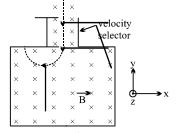
Two charged particle $A$ and $B$ each of charge $+e$ and masses $12$ $amu$ and $13$ $amu$ respectively follow a circular trajectory in chamber $X$ after the velocity selector as shown in the figure. Both particles enter the velocity selector with speed $1.5 \times 10^6 \,ms^{-1}.$ A uniform magnetic field of strength $1.0$ $T$ is maintained within the chamber $X$ and in the velocity selector.
At room temperature $\left(27^{\circ} \mathrm{C}\right)$, the resistance of a heating element is $50 \Omega$. The temperature coefficient of the material is $2.4 \times 10^{-4}{ }^{\circ} \mathrm{C}^1$. The temperature of the element, when its resistance is $62 \Omega$, is $\qquad$ ${ }^{\circ} \mathrm{C}$.
The number of turns and radius of cross-section of the coil of a tangent galvanometer are doubled. The reduction factor K will be
Like charges $........$ each other.
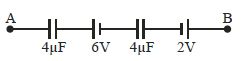
A part of circuit is given here, if $V_A-V_B = 4V$ then find charge on $4\,\mu F$ capacitor.....$\mu C$
$A$ curren of $2\,A$ is increasing at $a$ rate of $4\, A/s$ through a coil of inductance $2\,H$. The energy stored in the inductor per unit time is....$J/s$
Two electric bulbs rated ${P_1}\,watt$  $V\, volts$ and ${P_2}\, watt$ $V\, volts$ are connected in parallel and $V\, volts$ are applied to it. The total power will be
A ray of light passes through equilateral prism $(\mu  = 1.5)$ such that angle of incidence is equal to angle of emergence and the later is equal to $3/4^{th}$ of prism angle. The angle of deviation is....$^o$
Light of wavelength $\lambda$ strikes a photo-sensitive surface and electrons are ejected with kinetic energy E. If the kinetic energy is to be increased to 2E, the wavelength must be changed to $\lambda^{\prime}$ where