MCQ
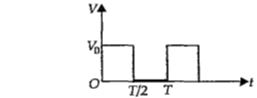
The $r.m.s.$ value of potential difference $V$ shown in the figure is 
  • A
    $\frac{{V_0}}{{\sqrt 3 }}$
  • B
    $V_0$
  • $\frac{{V_0}}{{\sqrt 2 }}$
  • D
    $\frac{{V_0}}{2}$

Answer

Correct option: C.
$\frac{{V_0}}{{\sqrt 2 }}$
c
$V=V_{0}$ for $0 \leq t \leq \frac{T}{2}$

$V=0$ for $\frac{T}{2} \leq t \leq T$

${V_{rms}} = \left[ {\frac{{\int\limits_0^T {{V^2}\,dt} }}{{\int\limits_0^T {dt} }}} \right] = {\left[ {\frac{{\int\limits_0^{T/2} {V_0^2\,dt}  + \int\limits_{T/2}^T {(0)\,dt} }}{{\int\limits_0^T {dt} }}} \right]^{1/2}}$

$ = {\left[ {\frac{{V_0^2}}{T}[t]_0^{T/2}} \right]^{1/2}}$

$ = {\left[ {\frac{{V_0^2}}{T}\left( {\frac{T}{2}} \right)} \right]^{1/2}}$

$ = {\left[ {\frac{{V_0^2}}{2}} \right]^{1/2}}$

${V_{rms}} = \frac{{{V_0}}}{{\sqrt 2 }}$
Need a full question paper?

Generate a complete, print-ready paper with questions like this in minutes — across 16+ boards, with answer keys.
Start Generating Free

Similar questions

The plane faces of two identical plano-convex lenses each having focal length of $40 cm$ are pressed against each other to form a usual convex lens. The distance from this lens, at which an object must be placed to obtain a real, inverted image with magnification one is.......$cm$
A convex lens makes a real image $4 cm$ long on a screen. When the lens is shifted to a new position without disturbing the object, we again get a real image on the screen which is $16 cm$ tall. The length of the object must be.......$cm$
The acceleration of an electron in an electric field of magnitude $50\, V/cm$, if $e/m$ value of the electron is $1.76 \times {10^{11}}\,C/kg$, is
In a transformer $220\, ac$ voltage is increased to $2200\, volts$. If the number of turns in the secondary are $2000$, then the number of turns in the primary will be
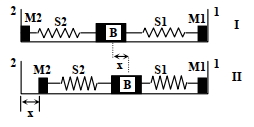
A block $(B)$ is attached to two unstretched springs $\mathrm{S} 1$ and $\mathrm{S} 2$ with spring constants $\mathrm{k}$ and $4 \mathrm{k}$, respectively (see figure $\mathrm{I}$ ). The other ends are attached to identical supports $M1$ and $M2$ not attached to the walls. The springs and supports have negligible mass. There is no friction anywhere. The block $\mathrm{B}$ is displaced towards wall $1$ by a small distance $\mathrm{x}$ (figure $II$) and released. The block returns and moves a maximum distance $\mathrm{y}$ towards wall $2$ . Displacements $\mathrm{x}$ and $\mathrm{y}$ are measured with respect to the equilibrium position of the block $B$. The ratio $\frac{y}{x}$ is Figure: $Image$
$A$ block of mass $m$ moving with a velocity $v_0$ on a smooth horizontal surface strikes and compresses a spring of stiffness $k$ till mass comes to rest as shown in the figure. This phenomenon is observed by two observers:

$A$: standing on the horizontal surface

$B$: standing on the block According to the observer $A$
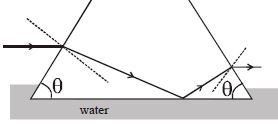
A glass prism whose cross-section is an isosceles  triangle stands with its (horizontal) base in water; the angles that its two equal sides make with the base are each $\theta$. An incident ray of light, above and parallel to the water surface is totally internally reflected at the glass-water interface and subsequently re-emerges into the air. Take the refractive indices of glass and water to be $\frac{3}{2}$ and $\frac{4}{3} $ , respectively. Maximum value of $cos\theta$ is.        
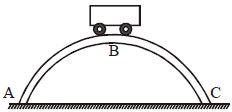
A car is moving on an overbridge of radius $R$ with a constant speed $v$. As the car is descending on the overbridge from point $B$ to $C,$ the normal reaction on it due to bridge
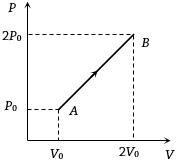
The $P-V$ diagram of $2$ gm of helium gas for a certain process $A \to B$ is shown in the figure. what is the heat given to the gas during the process $A \to B$
A motor car moving with a uniform speed of $20\,m/\sec $ comes to stop on the application of brakes after travelling a distance of $10\,m$ Its acceleration is..........$m/{\sec ^2}$