MCQ
The rough surface of a horizontal table offers a definite maximum opposing force to initiate the motion of a block along the table, which is proportional to the resultant normal force given by the table. Forces F1 and F2 act at the same angle θ with the horizontal and both are just initiating the sliding motion of the block along the table. Force F1 is a pulling force while the force F2 is a pushing force. F2 > F1, because
  • Component of F2 adds up to weight to increase the normal reaction.
  • B
    Component of F1 adds up to weight to increase the normal reaction.
  • C
    Component of F2 adds up to the opposing force.
  • D
    Component of F1 adds up to the opposing force.
Answer

Correct option: A.
Component of F2 adds up to weight to increase the normal reaction.

Need a full question paper?

Generate a complete, print-ready paper with questions like this in minutes — across 16+ boards, with answer keys.

Start Generating Free

Similar questions

For a progressive wave, in the usual notation
In an inertial frame of reference, a body performing uniform circular motion in clockwise direction has
A turn table which is rotating uniformly has a particle placed on it. As seen from the ground, the particle goes in a circle with speed 20 cm/s and acceleration $20 cm / s ^2$ The particle is now shifted to a new position where radius is half of the original value. The new values of speed and acceleration will be
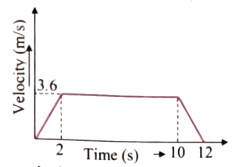
A lift is going up. The variation in the speed of the lift is as given in the graph. What is the height to which the lift takes the passengers?
Image
$S.I.$ unit of energy is joule and it is equivalent to
The side of a copper cube is $1 m$ at $0^{\circ} C$. What will be the change in its volume, when it is heated to $100^{\circ} C$ ? $\left(\alpha_{\text {copper }}=18 \times 10^{-6} /{ }^{\circ} C \right)$
A bullet hits and gets embedded in solid block resting on a frictionless surface. In this process which one of the following is correct?
The centre of mass of a system of three particles of masses 1 g, 2 g and 3 g is taken as the origin of a coordinate system. The position vector of a fourth particle of mass 4 g such that the centre of mass of the four particle system lies at the point (1, 2, 3) is $\alpha(\hat{i}+2 j+3 \hat{k})$, where $\alpha$ is a constant. The value of $\alpha$ is
In a communication system, noise is most likely to affect the signal ………..
What force will change the velocity of a body of mass $1 \ kg$ from $20 \ m s^{-1}$ to $30 \ m s^{-1}$ in two seconds?