MCQ
The same radioactive nucleus may emit?
  • A
    All the three $\alpha,\ \beta$ and $\gamma$ one after another.
  • B
    All the three $\alpha,\ \beta$ and $\gamma$ radiations simultaneously.
  • C
    Only $\alpha$ and $\beta$ simultaneously.
  • D
    Only one $\alpha,\ \beta$ and $\gamma$ at a time.

Answer

  1. Only one $\alpha,\ \beta$ and $\gamma$ at a time.
Need a full question paper?

Generate a complete, print-ready paper with questions like this in minutes — across 16+ boards, with answer keys.

Start Generating Free

Similar questions

When ultraviolet rays incident on a metal surface, it causes no photoelectric effect but will occur due to incident of the following :
In annihilation process, in which an electron and a positron transform into two gamma rays, which property of electric charge is displayed?

The average number of prompt neutrons produced per fission of   is

(a) More than 5

(b) 3 to 5

(c) 2 to 3 

(d) 1 to 2

A sample of radioactive element has a mass of 10 gm at an instant t = 0.The approximate mass of this element in the sample after two mean lives is

(a) 2.50 gm

(b) 3.70 gm

(c) 6.30 gm

(d) 1.35 gm

Which of the following planets have rings around it

(a) Uranus

(b) Mars

(c) Jupiter

(d) Saturn

A heater coil is cut into two equal parts and only one part is now used in the heater. The heat generated will now be

(a) One fourth

(b) Halved

(c) Doubled

(d) Four times

Fast neutrons can easily be slowed down by

(a) The use of lead shielding

(b) Passing them through water

(c) Elastic collisions with heavy nuclei

(d) Applying a strong electric field

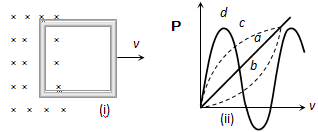
Figure (i) shows a conducting loop being pulled out of a magnetic field with a speed v. Which of the four plots shown in figure (ii) may represent the power delivered by the pulling agent as a function of the speed v

(a) a 

(b) b 

(c) c  

(d) d

A charged particle q is shot towards another charged particle Q which is fixed, with a speed v. It approaches Q upto a closest distance r and then returns. If q were given a speed 2v, the closest distances of approach would be

(a) r

(b) 2r

(c) r/2

(d) r/4

Magnetic lines of force due to a bar magnet do not intersect because

(a) A point always has a single net magnetic field

(b) The lines have similar charges and so repel each other

(c) The lines always diverge from a single point

(d) The lines need magnetic lenses to be made to intersect