Question
The same retarding force is applied to stop a train. The train stops after $80 m$. If the speed is doubled, then the distance will be

Answer

(d)Stopping distance $S \propto {u^2}$. If the speed is doubled then the stopping distance will be four times.

Need a full question paper?

Generate a complete, print-ready paper with questions like this in minutes — across 16+ boards, with answer keys.
Start Generating Free

Similar questions

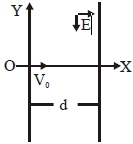
A charged particle $($mass $m$ and charge $q )$ moves along $X$ axis with velocity $V _{0}$. When it passes through the origin it enters a region having uniform electric field $\overrightarrow{ E }=- E \hat{ j }$ which extends upto $x = d$. Equation of path of electron in the region $x > d$ is 
A boat carrying steel balls is floating on the surface of water in a tank. If the balls are thrown into the tank one by one, how will it affect the level of water
A particle is performing simple harmonic motion with amplitude A and angular velocity ${\omega }$. The ratio of maximum velocity to maximum acceleration is
A triode has a plate resistance of $10 k \Omega$ and amplification factor $24$. If the input signal voltage is $0.4\, V$ $(r.m.s.)$, and the load resistance is $10\, k$ ohm, then, the output voltage $(r.m.s.)$ is......$V$
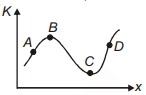
For a particle moving under the action of a variable force, kinetic energy-position graph is given, then
The $SI$ unit of mechanical equivalent of heat is
A tank $5\, m$ high is half-filled with water and then is filled to the top with oil of density $0.85\, g/cm^3$. The pressure at the bottom of the tank, due to these liquids is ....... $g\, dyne/cm^2$
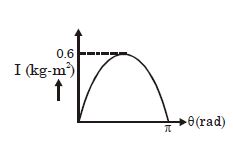
Figure shows the variation of the moment of inertia of a uniform rod, about an axis passing through its centre and inclined at an angle $\theta$ to the length. The moment of inertia of the rod about an axis passing through one of its ends and making an angle $\theta  = \frac{\pi }{3}$ will be ........ $ kg-m^2$.
A $0.10\, kg$ block oscillates back and forth along a horizontal surface. Its displacement from the origin is given by: $x = (10\,cm)\cos [(10\,rad/s)\,t + \pi /2\,rad]$. What is the maximum acceleration experienced by the block
The quality factor of $LCR$ circuit having resistance $(R)$ and inductance $(L)$ at resonance frequency ($\omega $) is given by