MCQ
The saponification produce:
  • Soap
  • B
    Oil
  • C
    Fatty acid
  • D
    Alcohals

Answer

Correct option: A.
Soap
Saponification is a process by which triglycerides are reacted with sodium or potassium hydroxide to produce.
Glycerol and fatty acid salt called soap.

Need a full question paper?

Generate a complete, print-ready paper with questions like this in minutes — across 16+ boards, with answer keys.
Start Generating Free

Similar questions

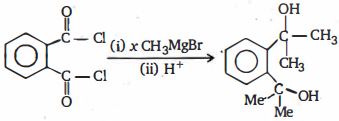
Number of moles of $CH_3MgBr$ consumed in above reaction is
White $P$ reacts with caustic soda, the products are $P{H_3}$ and $Na{H_2}P{O_2}$. This reaction is an example of
For the reaction $A + B \to $ products, what will be the order of reaction with respect to $A$ and $B$ ?
   Exp.    $[A]\,(mol\,L^{-1})$   $[B]\,(mol\,L^{-1})$   Initial rate    $(mol\,L^{-1}\,s^{-1})$ 
   $1.$  $2.5\times 10^{-4}$  $3\times 10^{-5}$  $5\times 10^{-4}$
   $2.$   $5\times 10^{-4}$  $6\times 10^{-5}$  $4\times 10^{-3}$
   $3.$   $1\times 10^{-3}$  $6\times 10^{-5}$  $1.6\times 10^{-2}$
The product of oxidation of $I^-$ with $\ce{MnO}_4^{-}$ in acidic medium is:
Which one of the following is not a close packing?
An isocyanide on hydrolysis gives
Which among the following statement is wrong regarding Mohr's salt
If Boiling point of water is $100\,^{\circ} C$. How much gram of $NaCl$ is added in $500\, g$ of water to increase the boiling point of water by approx.$1 \,^{\circ} C.\left( K _{ b }\right)_{ H_2O }=0.52\, K.\, kg / mole$
The atomic number of vanadium $(V)$, chromium  $(Cr)$, manganese $ (Mn)$  and iron $(Fe) $ are respectively $ 23,\, 24, \,25 $ and $ 26 $ which one of these may be expected to have the highest second ionization enthalpy
On the basis of information given below mark the correct option.Information:
  1. In bromoethane and chloroethane mixture intermolecular interactions of $A–A$ and $B–B$ type are nearly same as $A–B$ type interactions.
  2. In ethanol and acetone mixture $A–A$ or $B–B$ type intermolecular interactions are stronger than $A–B$ type interactions.
  3. In chloroform and acetone mixture $A–A$ or $B–B$ type intermolecular interactions are weaker than $A–B$ type interactions.