MCQ
The scale on a steel metre stick is calibrated at $20^o\,C$.The error in the reading of $50\,cm$ at $30^o\,C$ is: (take linear expansion coefficient of steel $= 1.0 \times 10^{-5} /  ^oC)$
  • A
    $10^{-3} \,cm$
  • B
    $2 \times 10^{-3} \,cm$
  • $5 \times 10^{-3} \,cm$
  • D
    $10^{-2} \,cm$

Answer

Correct option: C.
$5 \times 10^{-3} \,cm$
c
$\Delta \mathrm{L}=\mathrm{L}_{\mathrm{o}} \alpha \Delta \mathrm{t}$

$=(50 \mathrm{cm})\left(1.0 \times 10^{-5}/^{\circ}{C}\right)(30-20)^{\circ} \mathrm{C}$

$=5 \times 10^{-3} \mathrm{cm}$

Need a full question paper?

Generate a complete, print-ready paper with questions like this in minutes — across 16+ boards, with answer keys.

Start Generating Free

Similar questions

Find $\gamma$ for the mixture of $11\, gm CO _{2}$ and $14\, gm N _{2} ?$
A body of mass $M$ at rest explodes into three pieces, in the ratio of masses $1: 1: 2$. Two smaller pieces fly off perpendicular to each other with velocities of $30 \,ms ^{-1}$ and $40 \,ms ^{-1}$ respectively. The velocity of the third piece will be ............... $\,ms ^{-1}$
Add vectors $\overrightarrow{ A }, \overrightarrow{ B }$ and $\overrightarrow{ C }$ each having magnitude of $50$ unit and inclined to the $X$-axis at angles $45^{\circ}, 135^{\circ}$ and $315^{\circ}$ respectively.
Three rods each of length $L$ and mass $M$ are placed along $X$, $Y$ and $Z$ - axes in such a way that one end of each of the rod is at the origin. The moment of inertia of this system about $Z$ axis is
The efficiency of a Carnot engine depends upon
A train moves towards a stationary observer with speed $34\, m/s$. The train sounds a whistle and its frequency registered by the observer is $f_1$. If the speed of the train is reduced to $17\, m/s$, the frequency registered is $f_2$. If speed of sound is $340\, m/s$, then the ratio $f_1/f_2$ is
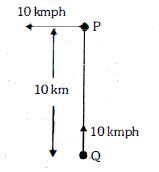
There are two particles $P$ and $Q$ separated by distance $10\ km$ and moving with velocities $10\ kmph$ as shown on a smooth horizontal surface. The time elapsed before they come at minimum separation is.........$hr$
A star of mass $M$ and radius $R$ is made up of gases. The average gravitational pressure compressing the star due to gravitational pull of the gases making up the star depends on $R$ as
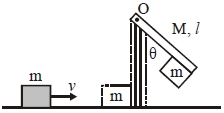
A block of mass $m =1\, kg$ slides with velocity $v=6\, m / s$ on a frictionless horizontal surface and collides with a uniform vertical rod and sticks to it as shown. The rod is pivoted about $O$ and swings as a result of the collision making angle $\theta$ before momentarily coming to rest. If the rod has mass $M =2 \,kg $ and length $l=1\, m$ the value of $\theta$ is approximately

(Take $\left.g=10 \,m / s ^{2}\right)$

Match List$-I$ with List$-II$

List$-I$ List$-II$
$(a)$ Isothermal $(i)$ Pressure constant
$(b)$ Isochoric $(ii)$ Temperature constant
$(c)$ Adiabatic $(iii)$ Volume constant
$(d)$ Isobaric $(iv)$ Heat content is constant

Choose the correct answer from the options given below