The sensitivity of a galvanometer of resistance $406\, ohm$ is decreased by $30\, times$. The shunt used is .................. $\Omega$
Medium
Download our app for free and get started
$\frac{\mathrm{i}}{\mathrm{i}_{\mathrm{g}}}=30 .$ The shunt $\mathrm{S}=\frac{\mathrm{Gi}_{\mathrm{g}}}{\mathrm{i}-\mathrm{i}_{\mathrm{g}}}=\frac{406}{29}=14\, \Omega.$

Download our appand get started for free
Experience the future of education. Simply download our apps or reach out to us for more information. Let's shape the future of learning together!No signup needed.*
Similar Questions
- 1An electron is moving in a circular path under the influence of a transverse magnetic field of $3.57 \times 10^{-2}\, T $. If the value of $e/m$ is $1.76 \times 10^{11}\, C/kg $, the frequency of revolution of the electron isView Solution
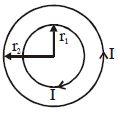
- 2Two circular concentric loops of radii $r_1 = 20\,cm$ and $r_2 = 30\,cm$ are placed in the $X, Y-$ plane as shown in the figure. A current $I = 7\,amp$ is flowing through them. The magnetic moment of this loop system isView Solution
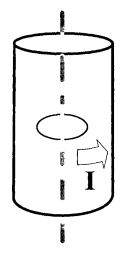
- 3A long circular tube of length $10 \ m$ and radius $0.3 \ m$ carries a current $I$ along its curved surface as shown. A wire-loop of resistance $0.005$ ohm and of radius $0.1 \ m$ is placed inside the tube with its axis coinciding with the axis of the tube. The current varies as $I=I_0 \cos (300 t)$ where $I_0$ is constant. If the magnetic moment of the loop is $N \mu_0 I_0 \sin (300 t)$, then ' $N$ ' isView Solution
- 4Proton with kinetic energy of $1\;MeV$ moves from south to north. It gets an acceleration of $10^{12}\; \mathrm{m} / \mathrm{s}^{2}$ by an applied magnetic field (west to east). The value of magnetic field :.......$mT$ (Rest mass of proton is $1.6 \times 10^{-27} \;\mathrm{kg}$ )View Solution
- 5A closely wounded circular coil of radius $5\,cm$ produces a magnetic field of $37.68 \times 10^{-4}\,T$ at its center. The current through the coil is $......A$. [Given, number of turns in the coil is $100$ and $\pi=3.14]$View Solution
- 6Statement $-1$ : Path of the charge particle may be straight line in uniform magnetic field.View Solution
Statement $-2$ : Path of the charge particle is decided by the angle between its velocity and the magnetic force working on it - 7Two ions have equal masses but one is singly ionized and second is doubly ionized. They are projected from the same place in a uniform transverse magnetic field with same velocity then:View Solution
$(a)$ Both ions will go along circles of equal radii
$(b)$ The radius of circle described by the single ionized charge is double of radius of circle described by doubly ionized charge
$(c)$ Both circle do not touches to each other
$(d)$ Both circle touches to each other - 8A wire of length $L$ metre carrying a current of $I$ ampere is bent in the form of circle. Its magnetic moment isView Solution
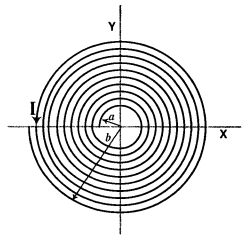
- 9A long insulated copper wire is closely wound as a spiral of ' $N$ ' turns. The spiral has inner radius ' $a$ ' and outer radius ' $b$ '. The spiral lies in the $X-Y$ plane and a steady current ' $I$ ' flows through the wire. The $Z$-component of the magnetic field at the center of the spiral isView Solution
- 10A steady current $I$ goes through a wire loop $\mathrm{PQR}$ having shape of a right angle triangle with $\mathrm{PQ}=3 x, \mathrm{PR}=4 x$ and $\mathrm{QR}=5 x$. If the magnitude of the magnetic field at $\mathrm{P}$ due to this loop is $k\left(\frac{\mu_0 I}{48 \pi x}\right)$, find the value of $k$.View Solution