MCQ
The sensitivity of a tangent galvanometer is increased if
  • A
    Number of turn decreases
  • Number of turn increases
  • C
    Field increases
  • D
    None of the above

Answer

Correct option: B.
Number of turn increases
b
(b)Sensitivity $S = \frac{\theta }{i} = \frac{\theta }{{K\tan \theta }}$ where $K = \frac{{2R{B_H}}}{{{\mu _0}N}}$
For increasing sensitivity $K$ should be decreased and hence number of turns should be increased.

Need a full question paper?

Generate a complete, print-ready paper with questions like this in minutes — across 16+ boards, with answer keys.
Start Generating Free

Similar questions

If the refractive indices of crown glass for red, yellow and violet colours are respectively ${\mu _{r\,}},\,\,{\mu _y}$ and ${\mu _v}$, then the dispersive power of this glass would be
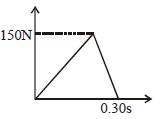
Two bodies $A$ and $B$ of masses $5.00\  kg$ and $10.0\  kg$ respectively moving in opposite directions with velocities $4.00\  m/s$ and $0.50\  m/s$ respectively make head-on collision in free space. The force of their mutual interaction varies according to the given graph. The coefficient of restitution is
A lens (focal length $50 cm$) forms the image of a distant object which subtends an angle of $1$ milliradian at the lens. What is the size of the image....$mm$
The distance between the plates of a parallel plate condenser is $8\,mm$ and $P.D.$ $120\;volts$. If a $6\,mm$ thick slab of dielectric constant $6$ is introduced between its plates, then
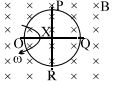
$A$ conducting ring of radius a is rotated about a point $O$ on its periphery as shown in the figure in a plane perpendicular to uniform magnetic field $B$ which exists everywhere. The rotational velocity is $\omega .$ Choose the correct statement $(s)$ related to the magnitude of potential differences
The impurity atoms which are mixed with pure silicon to make a $ P-$ type semiconductor are those of
A ring takes time ${t_1}$ in slipping down an inclined plane of length $L$ and takes time ${t_2}$ in rolling down the same plane. The ratio $\frac{{{t_1}}}{{{t_2}}}$ is
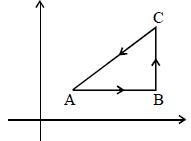
As shown in figure, on bringing a charge $Q$ from point $A$ to $B$ and from $B$ to $C$, the work done are $2\, joule$ and $-3\, joule$ respectively. The work done to bring the charge from $C$ to $A$ is
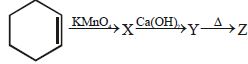
$Z$ is
$A$ conducting ring of radius a is rotated about a point $O$ on its periphery as shown in the figure in a plane perpendicular to uniform magnetic field $B$ which exists everywhere. The rotational velocity is $\omega .$ Choose the correct statement $(s)$ related to the potential of the points $P, Q$ and $R$