Question
The separation between the objective and the eyepiece of a compound microscope can be adjusted between 9.8cm to 11.8cm. If the focal lengths of the objective and the eyepiece are 1.0cm and 6cm respectively, find the range of the magnifying power if the image is always needed at 24cm from the eye.

Answer

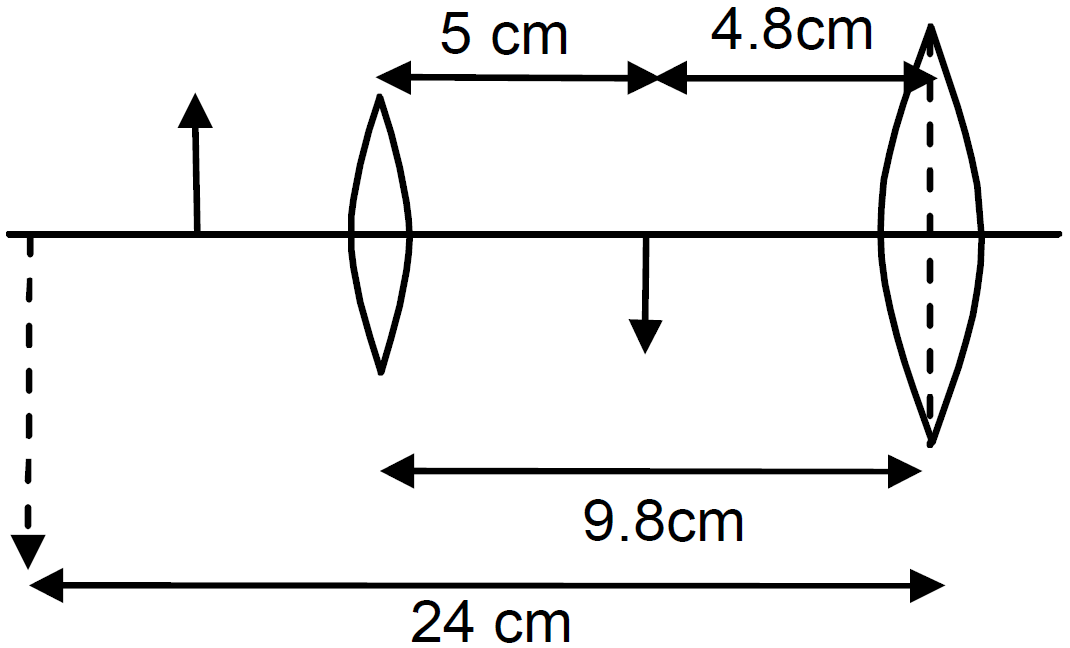
For the given compound microscope

f0 = 1cm, fe = 6cm, D = 24cm

For the eye piece, ve = -24cm, fe = 6cm

Now, $\frac{1}{\text{v}_\text{e}}-\frac{1}{\text{u}_\text{e}}=\frac{1}{\text{f}_\text{e}}$

$\Rightarrow\frac{1}{\text{u}_\text{e}}=\frac{1}{\text{v}_\text{e}}-\frac{1}{\text{f}_\text{e}}\Rightarrow-\Big[\frac{1}{24}+\frac{1}{6}\Big]=-\frac{5}{24}$

$\Rightarrow \text{u}_\text{e}=-4.8\text{cm}$

  1. When the separation between objective and eye piece is 9.8cm, the image distance for the objective lens must be (9.8) - (4.8) = 5.0cm

Now, $\frac{1}{\text{v}_0}-\frac{1}{\text{u}_0}=\frac{1}{\text{f}_0}$

$\Rightarrow\frac{1}{\text{u}_0}=\frac{1}{\text{v}_0}-\frac{1}{\text{f}_0}=\frac{1}{5}-\frac{1}{1}=-\frac{4}{5}$

$\Rightarrow\text{u}_0=-\frac{5}{4}=-1.25\text{cm}$

So, the magnifying power is given by,

$\text{m}=\frac{\text{v}_0}{\text{u}_\text{0}}\Big[1+\frac{\text{D}}{\text{f}}\Big]=\frac{-5}{-1.25}\Big[1+\frac{24}{6}\Big]=4\times5=20$
  1.  When the separation is 11.8cm,

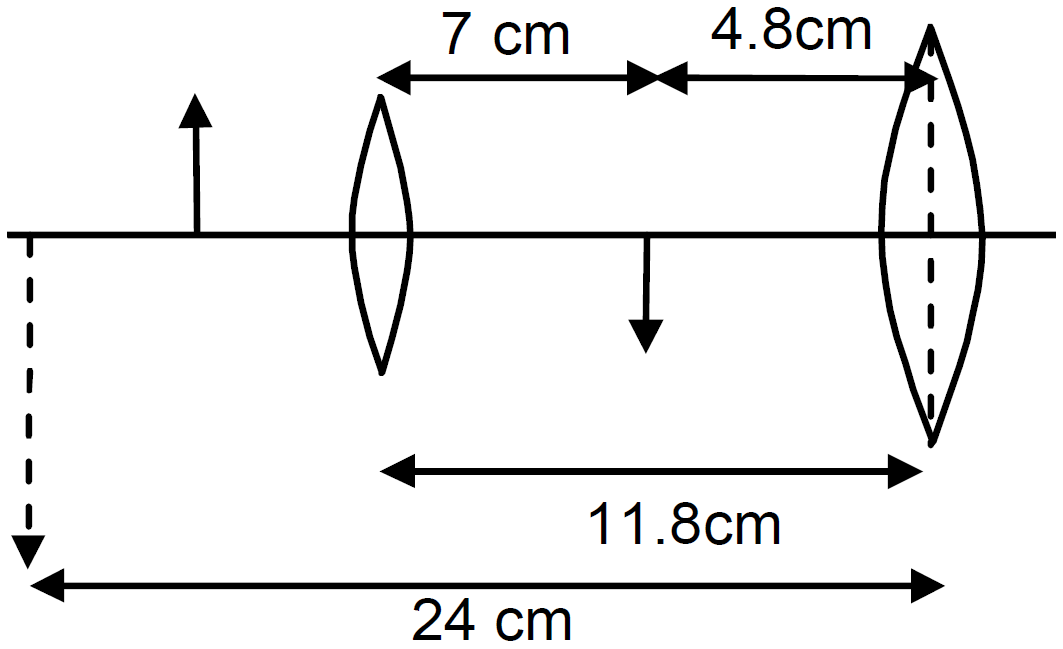
v0 = 11.8 - 4.8 = 7.0cm, f0 = 1cm

$\Rightarrow\frac{1}{\text{u}_0}=\frac{1}{\text{v}_0}-\frac{1}{\text{f}_0}=\frac{1}{7}-\frac{1}{1}=-\frac{6}{7}$

So, $\text{m}=-\frac{\text{v}_0}{\text{u}_\text{o}}\Big[1+\frac{\text{D}}{\text{f}}\Big]=\frac{-7}{-\Big(\frac{7}{6}\Big)}\Big[1+\frac{24}{6}\Big]=6\times5=30$

So, the range of magnifying power will be 20 to 30.
Need a full question paper?

Generate a complete, print-ready paper with questions like this in minutes — across 16+ boards, with answer keys.

Start Generating Free

Similar questions

An ideal gas is trapped between a mercury column and the closed-end of a narrow vertical tube of uniform base containing the column. The upper end of the tube is open to the atmosphere. The atmospheric pressure equals 76cm of mercury. The lengths of the mercury column and the trapped air column are 20cm and 43cm respectively. What will be the length of the air column when the tube is tilted slowly in a vertical plane through an angle of 60°? Assume the temperature to remain constant.
Explain graphically the flow of current in semiconductors in the presence of an external electric field.
The $\text{K}_\alpha$ and $\text{K}_\beta$ X-rays of molybdenum have wavelengths 0.71A and 0.63A respectively. Find the wavelength of $\text{L}_\alpha$ X-ray of molybdenum.
A light beam of wavelength 400 run is incident on a metal plate of work function 2.2eV.
  1. A particular electron absorbs a photon and makes two collisions before coming out of the metal. Assuming that 10% of the extra energy is lost to the metal in each collision, find the kinetic energy of this electron as it comes out of the metal.
  2. Under the same assumptions, find the maximum number of collisions the electron can suffer before it becomes unable to come out of the metal.
A normal eye has retina 2cm behind the eye-lens. What is the power of the eye-lens when the eye is
  1. Fully relaxed,
  2. Most strained?
Suppose the space between the two inner shells of the previous problem is filled with a dielectric of dielectric coastant K. Find the capacitance of the system between A and B.
Show that the first few frequencies of light that is emitted when electrons fall to the nth level from levels higher than n, are approximate harmonics (i.e. in the ratio 1 : 2: 3...) when n > > 1.
Find the current in the sliding rod AB (resistance = R) for the arrangement shown in Fig. B is constant and is out of the paper. Parallel wires have no resistance. v is constant. Switch S is closed at time t = 0.

A group of students while coming from the school noticed a box marked "Danger H.T. 2200 V" at a substation in the main street. They did not understand the utility of such a high voltage, while they argued, the supply was only 220 V.They asked their teacher this question the next day. The teacher thought it to be an important question and therefore explained to the whole class.
Answer the following questions:
  1. What device is used to bring the high voltage down to low voltage of a.c. Current and what is the principle of its working?
  2. Is it possible to use this device for bringing down the high d.c. Voltage to the low voltage? Explain.
  3. Write the values displayed by the students and the teacher.
The half-life of 40K is 1.30 × 10⁹y. A sample of 1.00g of pure KCI gives 160 counts/ s. Calculate the relative abundance of 40K (fraction of 40K present) in natural potassium.