Question
The separation between the plates of a charged parallel-plate capacitor is increased. Which of the following quantities will change?
  1. Charge on the capacitor.
  2. Potential difference across the capacitor.
  3. Energy of the capacitor.
  4. Energy density between the plates.

Answer

  1. Potential difference across the capacitor.
  2. Energy of the capacitor.

Explanation:

Because the charge always remains conserved in an isolated system, it will remain the same.

Now,

$\text{V}=\frac{\text{Qd}}{\in_0\text{A}}$

Here, Q, A and d are the charge, area and distance between the plates, respectively.

Thus, as d increases, V increases.

Energy is given by:

$\text{E}=\frac{\text{qV}}{2}$ 

So, it will also increase.

Energy density u, that is, energy stored per unit volume in the electric field is given by:

$\text{u}=\frac{1}{2}\in_0\text{E}^2$

So, u will remain constant with increase in distance between the plates.

Need a full question paper?

Generate a complete, print-ready paper with questions like this in minutes — across 16+ boards, with answer keys.

Start Generating Free

Similar questions

A particle move on an circular overbridge with constant speed. The friction coefficient varies so that the speed remains constant. Which of the following graph shows the magnitude of friction
The ratio of kinetic energy of a planet at perigee and apogee during its motion around the sun in elliptical orbit of eccentricity $e$ is ..........
If the units of force, energy and velocity are respectively $10\, N, 100\, J, 5\, m/s$, then  the units of length, mass and time will be
The image formed by a concave mirror:
  1. Is always real.
  2. Is always virtual.
  3. Is certainly real if the object is virtual.
  4. Is certainly virtual if the object is real.
The projection of a vector $\vec r\, = \,3\hat i\, + \,\hat j\, + \,2\hat k$ on the $xy$ plane has magnitude
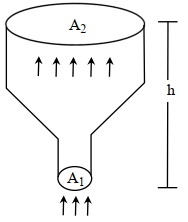
An ideal gas of density $\rho=0.2 kg m ^{-3}$ enters a chimney of height $h$ at the rate of $\alpha=0.8 kg s ^{-1}$ from its lower end, and escapes through the upper end as shown in the figure. The cross-sectional area of the lower end is $A_1=0.1 m ^2$ and the upper end is $A_2=0.4 m ^2$. The pressure and the temperature of the gas at the lower end are $600 Pa$ and $300 K$, respectively, while its temperature at the upper end is $150 K$. The chimney is heat insulated so that the gas undergoes adiabatic expansion. Take $g=10 ms ^{-2}$ and the ratio of specific heats of the gas $\gamma=2$. Ignore atmospheric pressure.

Which of the following statement($s$) is(are) correct?

A particle performs harmonic oscillations along a straight line with a period of 6s and amplitude 4cm. The mean velocity of the particle averaged over the time interval during which it travels a distance of 2cm starting from the extreme position is:
When an arrow is released from a bow, potential energy changes into kinetic energy.
Three copper blocks of masses M1, M2 and M3kg respectively are brought into thermal contact till they reach equilibrium. Before contact, they were at T1, T2, T3 (T1 > T2 > T3). Assuming there is no heat loss to the surroundings, the equilibrium temprature T is (s is specific heat of copper)
A rocket has a mass of $100 \,kg$. $90\%$ of this is fuel. It ejects fuel vapours at the rate of $1 \,kg/sec$ with a velocity of $500\, m/sec$ relative to the rocket. It is supposed that the rocket is outside the gravitational field. The initial upthrust on the rocket when it just starts moving upwards  is ......... $N$