MCQ
The separation between two microscopic particles is measured $P_A$ and $P_B$ by two different lights of wavelength $2000 \mathring A$ and $3000 \mathring A$ respectively, then
  • A
    $P_A > P_B$
  • $P_A$
  • C
    $P_A<3 / 2 P_B$
  • D
    $P_A=P_B$

Answer

Correct option: B.
$P_A$
Resolving limit (minimum separation) $\propto \lambda$
$\Rightarrow \frac{P_A}{P_B}=\frac{2000}{3000} \Rightarrow P_A$

Need a full question paper?

Generate a complete, print-ready paper with questions like this in minutes — across 16+ boards, with answer keys.
Start Generating Free

Similar questions

The inductance of a coil is $60 \mu \mathrm{H}$. A current in this coil increases from $1.0 A$ to $1.5 A$ in $0.1$ second. The magnitude of the induced e.m.f. is
In the $C B$ mode of a transistor, when the collector voltage is changed by $0.5$ volt. The collector current changes by $0.05\ mA$. The output resistance will be
A lens of power $+2$ diopters is placed in contact with a lens of power $-1$ diopoter. The combination will behave like
If the value of potential in an ac, circuit is $10 V$, then the peak value of potential is
Two satellite $A$ and $B$, ratio of masses $3: 1$ are in circular orbits of radii $r$ and $4 r$. Then ratio of total mechanical energy of $A$ to $B$ is
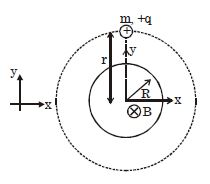
Circular region of radius $R$ has uniform magnetic field $B = {B_0} + {B_0}t\left( { - \hat k} \right).\,At\,\,t\, = 0\,$ acceleration of charged particle 
An electric motor creates a tension of 4500 newton in a hoisting cable and reels it in at the rate of $2 \mathrm{~m} / \mathrm{sec}$. What is the power of electric motor
A potentiometer having the potential gradient of $2\  \mathrm{mV} / \mathrm{cm}$ is used to measure the difference of potential across a resistance of $10\  \mathrm{ohm}$. If a length of $50 \mathrm{~cm}$ of the potentiometer wire is required to get the null point, the current passing through the $10\  \mathrm{ohm}$ resistor is (in $m A)$
In the lowest energy level of hydrogen atom, the electron has the angular momentum
The escape velocity of a particle of mass $m$ varies as