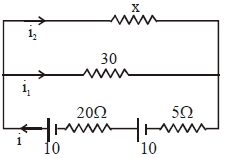
The series combination of two batteries, both of the same emf $10 \mathrm{\;V},$ but different internal resistance of $20\; \Omega$ and $5\; \Omega,$ is connected to the parallel combination of two resistors $30\; \Omega$ and $\mathrm{R}\; \Omega .$ The voltage difference across the battery of internal resistance $20\; \Omega$ is zero, the value of $\mathrm{R}(\text { in } \Omega)$ is
JEE MAIN 2020, Diffcult


Download our appand get started for free
Experience the future of education. Simply download our apps or reach out to us for more information. Let's shape the future of learning together!No signup needed.*
Similar Questions
- 1A potential difference of $V$ is applied at the ends of a copper wire of length $l$ and diameter $d$. On doubling only $d$, drift velocityView Solution
- 2View SolutionIf in the experiment of Wheatstone's bridge, the positions of cells and galvanometer are interchanged, then balance points will
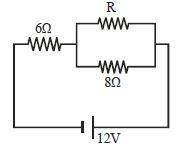
- 3In the circuit shown in figure, the power which is dissipated as heat in the $6\,\Omega $ resistor is $6\,W$. What is the value of resistance $R$ in the circuit? ................ $\Omega$View Solution
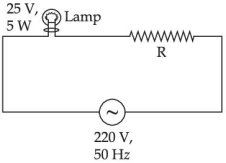
- 4A $220 \; V , 50 \; Hz$ AC source is connected to a $25 \; V$, $5 \; W$ lamp and an additional resistance $R$ in series (as shown in figure) to run the lamp at its peak brightness, then the value of $R$ (in ohm) will beView Solution
- 5View SolutionWhich is a wrong statement
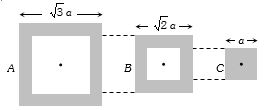
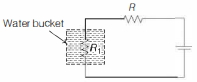
- 6View SolutionThe circuit below is used to heat water kept in a bucket. Assuming heat loss only by Newton's law of cooling, the variation in the temperature of the water in the bucket as a function of time is depicted by
- 7$3$ identical bulbs are connected in series and these together dissipate a power $P$. If now the bulbs are connected in parallel, then the power dissipated will beView Solution
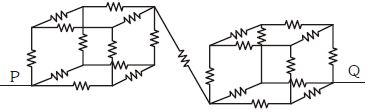
- 8Find the equivalent resistance between $P$ and $Q.$ (If each wire has a resistance $R$ )View Solution
- 9The resistance of a wire of iron is $10\, ohms$ and temp. coefficient of resistivity is $5 \times {10^{ - 3}}\,^oC$. At $20\,^oC$ it carries $30$ milliamperes of current. Keeping constant potential difference between its ends, the temperature of the wire is raised to $120\,^oC$. The current in milliamperes that flows in the wire isView Solution
- 10Following figure shows cross-sections through three long conductors of the same length and material, with square cross-section of edge lengths as shown. Conductor $B$ will fit snugly within conductor $A$, and conductor $C$ will fit snugly within conductor $B$. Relationship between their end to end resistance isView Solution