Question
The set of points where the function f(x) = x |x| is differentiable is:
  1. $(-\infty,\infty)-\infty,\infty$
  2. $(-\infty,0)\cup(0,\infty)-\infty,0\cup0,\infty$
  3. $(0,\infty)0,\infty$
  4. $[0,\infty]0,\infty$

Answer

  1. $(-\infty,\infty)$

Solution:

We have,

$\text{f(x)}=\text{x}|\text{x}|$

$\Rightarrow\text{f(x)}=\begin{cases}-\text{x}^2, & \text{x}<0\\0 ,& \text{x}= 0\\\text{x}^2,&\text{x}>0\end{cases}$

When, x < 0, we have

f(x) = -x2 which being a polynomial function is continuous and differentable in $(-\infty,0)$

When, x > 0, we have

f(x) = -x2 which being a polynomial function is continuous and differentable in $(0,\infty,)$

Thus possible point of non-differentiability of f(x) is x = 0

Now, LHL (at x = 0) $=\lim\limits_{\text{x}\rightarrow0^{-}}\frac{\text{f(x)}-\text{f}(0)}{\text{x}-0}$

$=\lim\limits_{\text{x}\rightarrow0^{-}}\frac{-\text{x}^2-0}{\text{x}}$

$=\lim\limits_{\text{h}\rightarrow0}\frac{-(-\text{h})^2}{-\text{h}}$

$=\lim\limits_{\text{h}\rightarrow0}\text{h}$

$=0$

And RHL (at x = 0) $=\lim\limits_{\text{x}\rightarrow0^{+}}\frac{\text{f(x)}-\text{f}(0)}{\text{x}-0}$

$=\lim\limits_{\text{x}\rightarrow0^{+}}\frac{\text{x}^2-0}{\text{x}}$

$=\lim\limits_{\text{h}\rightarrow0}\frac{\text{h}^2}{\text{h}}$

$=\lim\limits_{\text{h}\rightarrow0}\text{h}$

$=0$

$\therefore$ LHL (at x = 0) = RHL (at x = 0)

So, f(x) is also differentiable at x = 0

i.e. f(x) is differentiable in $(-\infty,\infty).$
Need a full question paper?

Generate a complete, print-ready paper with questions like this in minutes — across 16+ boards, with answer keys.

Start Generating Free

Similar questions

$\int_{}^{} {\sqrt {{x^2} - 8x + 7} } \;dx = $
For $x > 0,$ if $f(x)=\int_{1}^{x} \frac{\log _{e} t}{(1+t)} d t,$ then $f(e)+f\left(\frac{1}{e}\right)$ is equal to ...... .
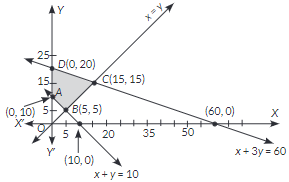
Based on the given shaded region as the feasible region in the graph, at which point(s) is the objective function $Z=3 x+9 y$ maximum?
Image
$\int_{}^{} {{e^{2x}}\left( {\frac{{\sin 4x - 2}}{{1 - \cos 4x}}} \right)\;dx = } $
Let $f(x)=1+\frac{x}{1 !}+\frac{x^2}{2 !}+\frac{x^3}{3 !}+\frac{x^4}{4 !}$. The number of real roots of $f(x)=0$ is
If $\text{P(A)}=\frac{2}{5},\text{P(B)}=\frac{3}{10}$ and $\text{P}(\text{A}\cap\text{B})=\frac{1}{5},$ then, $\text{P}(\overline{\text{A}}|\overline{\text{B}}) \text{ P}(\overline{\text{B}}|\overline{\text{A}})$ is equal to
  1. $\frac{5}{6}$
  2. $\frac{5}{7}$
  3. $\frac{25}{42}$
  4. $1$
$\big(\vec{\text{a}}+2\vec{\text{b}}-\vec{\text{c}}\big).\big\{\big(\vec{\text{a}}-\vec{\text{b}}\big)\times\big(\vec{\text{a}}-\vec{\text{b}}-\vec{\text{c}}\big)\big\}$ is equal to:
  1. $\big[\vec{\text{a}}\vec{\text{b}}\vec{\text{c}}\big)$
  2. $2\big[\vec{\text{a}}\vec{\text{b}}\vec{\text{c}}\big)$
  3. $3\big[\vec{\text{a}}\vec{\text{b}}\vec{\text{c}}\big)$
  4. $0$
Choose the correct answer from the given four options.
In a college, 30% students fail in physics, 25% fail in mathematics and 10% fail in both. One student is chosen at random. The probability that she fails in physics if she has failed in mathematics is:
$\int_{}^{} {{{\sec }^4}x\tan x\;dx = } $ 
The minimum value of Z = 4x + 3y subjected to the constraints $3\text{x}+2\text{y}\geq160,$ $5+2\text{y}\geq200,$$ 2\text{y}\geq80;\text{x},\text{y}\geq0$ is:
  1. 220
  2. 300
  3. 230
  4. None of these