MCQ
The shape of carbonium is
  • Planar
  • B
    Pyramidal
  • C
    Linear
  • D
    None of these

Answer

Correct option: A.
Planar
a
(a) Carbonium ion is planar species

Need a full question paper?

Generate a complete, print-ready paper with questions like this in minutes — across 16+ boards, with answer keys.
Start Generating Free

Similar questions

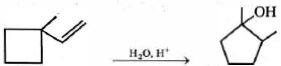
How many transition states and intermediates will be formed during the course of following reaction ?
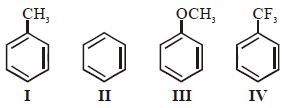
Find the decreasing order of reactivity towards electrophilic substitution reaction
The average molar mass of air becomes more in presence of which gas if present in air :
One mole of an ideal gas at $350\,K$ is in a $2.0\,L$ vessel of thermally conducting walls, which are in contact with the surroundings. It undergoes isothermal reversible expansion from $2.0\,L$ to $3.0\,L$ against a constant pressure of $4\,atm$. The change in entropy of the surroundings $(\Delta S )$ is $......\,J\,K ^{-1}$ (Nearest integer) Given : $R =8.314\,J\,K ^{-1}\,Mol ^{-1}$.
The correct order of increasing intermolecular hydrogen bond strength is .... .
The addition of $HCl$ will not suppress the ionization of
Number of atoms in $24\, g$ of $He$ is ............ $\mathrm{N_A}$
Oxidising power of chlorine in aqueous solution can be determined by the parameters indicated below :

$\frac{1}{2}C{l_2}(g)\xrightarrow{{\frac{1}{2}{\Delta _{diss}}{H^\Theta }}}Cl(g)\xrightarrow{{{\Delta _{eg}}{H^\Theta }}}$ $C{l^ - }(g)\xrightarrow{{{\Delta _{Hyd}}{H^\Theta }}}C{l^ - }(aq)$

(using the data, 

${{\Delta _{diss}}H_{C{l_2}}^\Theta } = 240\,kJ\,mol^{-1}, {{\Delta _{eg}}H_{C{l}}^\Theta }= -349 \,kJ\,mol^{-1},$${{\Delta _{Hyd}}H_{C{l}}^\Theta }= -381 \,kJ\,mol^{-1}$ ) will be ............. $\mathrm{kJ\,mol}^{-1}$

To differentiate between carbon-$12$, carbon- $13$ and carbon- $14$, the instrument that you would use in
The $\Delta H_f^o$ for $CO_2 (g), CO(g)$ and $H_2O (g)$ are $-393.5, -110.5$ and $-241.8\, kJ\, mol^{-1}$ respectively. The standard enthalpy change (in $kJ$) for the reaction $CO_2 (g) + H_2 (g) \to CO (g) + H_2O (g)$ is