MCQ
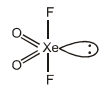
The shape of $XeO _2 F _2$ molecule is
  • A
    trigonal bipyramidal
  • B
    square plannar
  • C
    tetrahedral
  • see-saw

Answer

Correct option: D.
see-saw
d
$XeO _2 F _2$ has trigonal bipyramidal geometry. Due to presence of lone pair on equitorial position, the shape is see-saw.

Need a full question paper?

Generate a complete, print-ready paper with questions like this in minutes — across 16+ boards, with answer keys.

Start Generating Free

Similar questions

A gas expands from $3\,dm^3$ to $5.8\, dm^3$ against constant external pressure of $3$ $bar$. The work done during expansion is used to heat $2$ moles of water from $290\,K$ to final temperature of $T\,K$. If specific heat of water is $4.2\, J-gm^{-1} \,K^{-1}$, then $T=......K$
In the reaction The hybridisation states of carbon atoms $1, 2, 3, 4$ are

$_H^{Br} > \mathop C\limits_1  = \mathop C\limits_2  < _H^{Br}$ $\xrightarrow[{Catalyst}]{{{H_2}}}Br\mathop {C{H_2}}\limits_3 \mathop {C{H_2}}\limits_4 Br$

Identify the least stable ion amongst the following:
Which of the following compound will most easily be attacked by an electrophile?
In general, the properties that decrease and increase down a group in the periodic table respectively are
Group showing strongest +M effect:
In absence of formation of complex ions by the addition of a common ion, the solubility of a given salt is
Which carbonyl compound has maximum dipole moment
The $\mathrm{pH}$ of a solution obtained by mixing $50 \,\mathrm{~mL}$ of $1\, \mathrm{M}\, \mathrm{HCl}$ and $30 \,\mathrm{~mL}$ of $1\, \mathrm{M} \,\mathrm{NaOH}$ is $\mathrm{x} \times 10^{-4}$. The value of $\mathrm{x}$ is ...... . (Nearest integer) $[\log 2.5=0.3979]$
The thermal dissociation equilibrium of $CaCO _3( s )$ is studied under different conditions.

$CaCO _3( s ) \rightleftharpoons CaO ( s )+ CO _2( g )$

For this equilibrium, the correct statement(s) is (are)

$(A)$ $\Delta H$ is dependent on $T$

$(B)$ $K$ is independent of the initial amount of $CaCO _3$

$(C)$ $K$ is dependent on the pressure of $CO _2$ at a given $T$

$(D)$ $\Delta H$ is independent of the catalyst, if any