Question
The shows a circular wire loop of radius a and carrying a current $i,$ which is placed in a perpendicular magnetic field $B.$
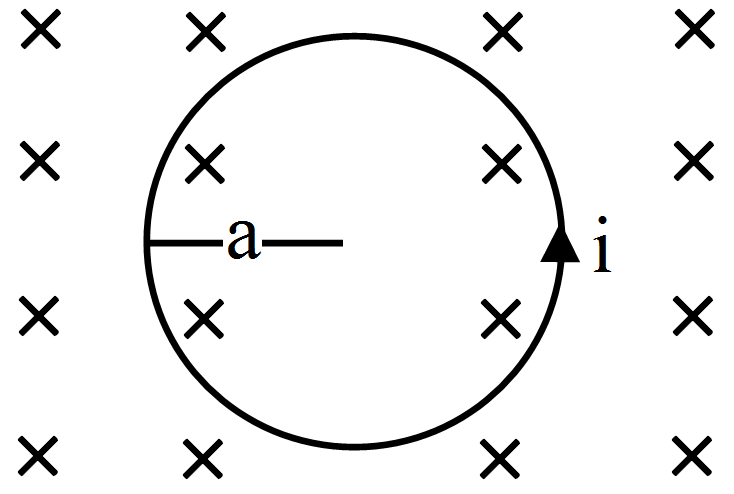
  1. Consider a small part $dl$ of the wire. Find the force on this part of the wire exerted by the magnetic field.
  2. Find the force of compression in the wire.
Answer

  1. $\text{Fdl} = i \times dl \times B$ towards centre. $($By cross product rule$)$
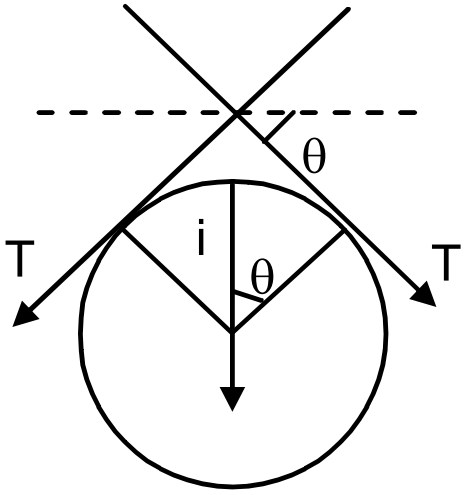
  2. Let the length of subtends an small angle of $20$ at the centre.
Here, $2\text{T}\sin\theta=\text{i}\times\text{dl}\times\text{B}$
$\Rightarrow2\text{T}\theta=\text{i}\times\text{a}\times2\theta\times\text{B}$ $[\text{As}\theta\rightarrow0,\ \theta\approx0]$
$\Rightarrow\text{T}=\text{i}\times\text{a}\times\text{B}$
$\text{dl}=\text{a}\times2\theta$
Force of compression on the wire $=\text{i}\text{aB}$

Need a full question paper?

Generate a complete, print-ready paper with questions like this in minutes — across 16+ boards, with answer keys.

Start Generating Free

Similar questions

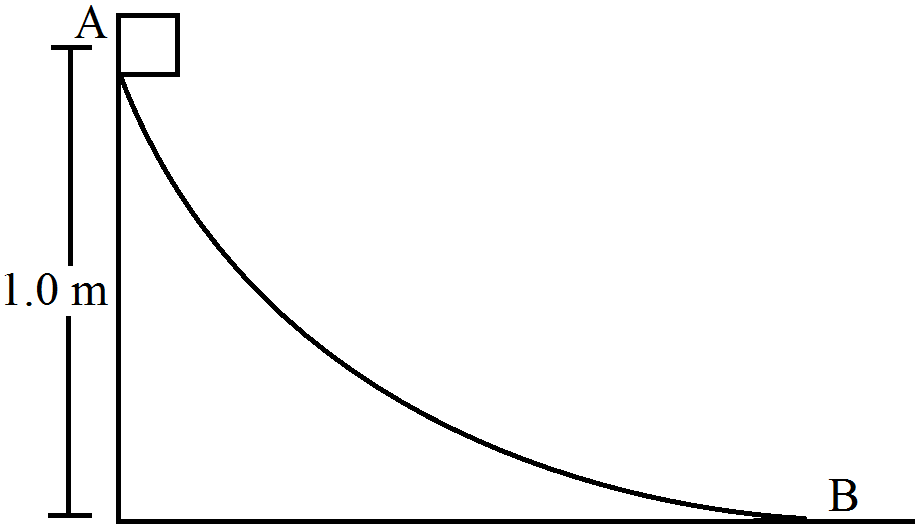
A block weighing 10N travels down a smooth curved track AB joined to a rough horizontal surface (figure). The rough surface has a friction coefficient of 0.20 with the block. If the block starts slipping on the track from a point 1.0m above the horizontal surface, how far will it move on the rough surface?
The potential barrier existing across an unbiased $p-n.$ junction is $0.2$ volt. What minimum kinetic energy a hole should have to diffuse from the $p-$side to the $n-$side if,
  1. The junction is unbiased.
  2. The junction is forwardbiased at $0.1$ volt.
  3. The junction is reverse$-$biased at $0.1$ volt?
Find an expression for viscous force $F$ acting on a tiny steel ball of radius $r$ moving in a viscous liquid of viscosity $n$ with a constant speed $v$ by the method of dimensional analysis.
In a refrigerator, heat from inside of a refrigerator at 270 K is transferred to a room at 300 K .
i. What is its coefficient of performance?
ii. How much heat will be delivered to the room for each joule of electric energy consumed? Assume the refrigerator to be an ideal one.
Derive a relation for the time taken by a projectile to reach the highest point and the maximum height attained?
On what factors the amount of heat flowing from hot face to the cold face depends? How?
Find a unit vector parallel to the vector $3\hat{\text{i}}+7\hat{\text{j}}+4\hat{\text{k}}.$
The number of particles crossing per unit area perpendicular to x-axis in unit time N is given by: $\text{N}=-\text{D}\Big(\frac{\text{n}_2-\text{n}_1}{\text{x}_2-\text{x}_1}\Big)\text{s}$ where $n_1$ and $n_2$ are the number of particles per unit volume at $x_1$ and $x_2​​​​​​​$ respectively. Deduce the dimensional formula for D.
  1. What is the scale factor of human relative to monkey in relation to heartbeats?
  2. What is the monkey's heart rate?
The bottom of a dip on a road has a radius of curvature R. A rickshaw of mass M left a little away from the bottom oscillates about this dip. Deduce an expression for the period of oscillation.