MCQ
The SI unit of capacitance is:
  • A
    Henry.
  • B
    Hertz.
  • Farad.
  • D
    None.

Answer

Correct option: C.
Farad.

Need a full question paper?

Generate a complete, print-ready paper with questions like this in minutes — across 16+ boards, with answer keys.
Start Generating Free

Similar questions

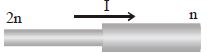
Two cylindrical rods of uniform crosssection area $A$ and $2A$, having free electrons per unit volume $2n$ and $n$ respectively are joined in series. A current $I$ flows through them in steady state. Then the ratio of drift velocity of free electron in left rod to drift velocity of electron in the right rod is $\left( {\frac{{{v_L}}}{{{v_R}}}} \right)$
The mutual inductance between two coils is $1.25$ $henry$. If the current in the primary changes at the rate of $80$ $ampere/second,$ then the induced $e.m.f$ in the secondary is......$V$
A short magnet oscillates with a time period 0.1 s at a place where horizontal magnetic field is 24μT. A downward current of 18 A is established in a vertical wire 20 cm east of the magnet. The new time period of oscillator
In the Davisson and Germer experiment, the velocity of electrons emitted from the electron gun can be increased by?
What was the fissionable material used in bomb dropped at Nagasaki (Japan) in the year $1945$ ?
Which one of the following device makes use of the electrons to strike certain substances to produce fluorescence?
A capacitor is kept connected to the battery and a dielectric slab is inserted between the plates. During this process
A radioactive substance has a half life of $60\, minutes$. After $3\, hours$, the fraction of atom that have decayed would be ......... $\%$
Two concentric coplanar circular loops of radii $r_1$ and $r_2$ carry currents of respectively $i_1$ and $i_2$ in opposite directions (one clockwise and the other anticlockwise.) The magnetic induction at the centre of the loops is half that due to $i_1$ alone at the centre. If $r_2=2r_1$. the value of $i_2/i_1$ is
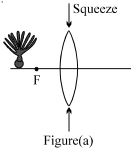
$A$ turnip sits before a thin converging lens, outside the focal point of the lens. The lens is filled with a transparent gel so that it is flexible; by squeezing its ends toward its center [as indicated in figure $(a)$], you can change the curvature of its front and rear sides. The lateral height of image.