MCQ
The smallest among the following ions is
  • A
    $N{a^ + }$
  • B
    $M{g^{ + 2}}$
  • C
    $B{a^{2 + }}$
  • $A{l^{3 + }}$

Answer

Correct option: D.
$A{l^{3 + }}$
d
$(d)$ The size of an species decreases with increasing nuclear charge because the attraction for the electrons increases. Thus $A{l^{3 + }}$is smaller in size.

Need a full question paper?

Generate a complete, print-ready paper with questions like this in minutes — across 16+ boards, with answer keys.

Start Generating Free

Similar questions

Assuming ideal behaviour, the magnitude of $log \, K$ for the following reaction at $25^{\circ} C$ is $x \times 10^{-1} .$ The value of $x$ is $...... .$ (Integer answer)

$3 HC \equiv CH _{( g )} \rightleftharpoons C _{6} H _{6(\ell)}$

[Given: $\Delta_{f} G ^{\circ}( HC \equiv CH )=-2.04 \times 10^{5}\, J mol ^{-1}$

$\Delta_{f} G ^{\circ}\left( C _{6} H _{6}\right)=-1.24 \times 10^{5}\, J mol ^{-1} ; R =8.314\,\left. J K ^{-1} mol ^{-1}\right]$
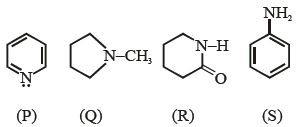
Write the order of basic strength
The work done during reversible isothermal expansion of one mole of hydrogen gas at $25^{\circ} \mathrm{C}$ from pressure of $20 \mathrm{atmosphere} \mathrm{to} 10 \mathrm{atmosphere}$ is

(Given $R=2.0 \mathrm{cal} \mathrm{K}^{-1} \mathrm{~mol}^{-1}$ )

 $\begin{array}{*{20}{c}}
  {C{H_3} - CH - C{H_2} - C{H_3}\xrightarrow[\Delta ]{{KOH}}product} \\ 
  {|\,\,\,\,\,\,\,\,\,\,\,\,\,\,\,\,\,\,\,\,\,\,\,\,\,\,\,\,\,\,\,\,\,\,\,\,\,\,\,\,\,\,\,\,\,\,\,\,\,\,\,\,\,\,\,\,\,\,\,\,} \\ 
  {Cl\,\,\,\,\,\,\,\,\,\,\,\,\,\,\,\,\,\,\,\,\,\,\,\,\,\,\,\,\,\,\,\,\,\,\,\,\,\,\,\,\,\,\,\,\,\,\,\,\,\,\,\,\,\,\,\,\,\,\,} 
\end{array}$

Possible number of elimination products (alkene) of the given reaction is?

Match List $- I$ with List $- II.$

List $- I$

List $- II$

$(a)$ Zymase $(i)$ Stomach
$(b)$ Diastase $(ii)$ Yeast
$(c)$ Urease $(iii)$ Malt
$(d)$ Pepsin $(iv)$ Soyabean

Choose the correct answer from the options given below

What is the product of following reaction ?

$Hex - 3 - ynal\xrightarrow[\begin{subarray}{l} 
  (ii)\,PB{r_3} \\ 
  (i)\,Mg/ether \\ 
  (i)\,C{O_2}/{H_3}{O^ + } 
\end{subarray} ]{{(i)\,NaB{H_4}}}\,?$
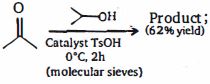
Nitrosobenzene can be prepared by oxidizing aniline from
In the periodic table first transition series is placed in
The principal reason that the melting point of $NaF$ is much higher then that of $RbBr$ is that
Product of the reaction is