MCQ
The solid angle subtended by the periphery of an area $1\ cm^2$ at a point situated symmetrically at a distance of $5\ cm$ from the area is:
  • A
    $2 \times 10^{-2}$ steradian.
  • $4 \times 10^{-2}$ steradian.
  • C
    $6 \times 10^{-2}$ steradian.
  • D
    $8 \times 10^{-2}$ steradian.

Answer

Correct option: B.
$4 \times 10^{-2}$ steradian.
Solid angle, $\text{d}\Omega=\frac{\text{dA}}{\text{r}^2}=1\text{cm}^2/(\text{ 5cm})^2$
$=0.04$ steradian
$=4\times10^{-2}$ steradian

Need a full question paper?

Generate a complete, print-ready paper with questions like this in minutes — across 16+ boards, with answer keys.

Start Generating Free

Similar questions

A machine gun fires a bullet of mass $40\, g$ with a velocity $1200\, ms^{-1}$. The man  holding it, can exert maximum force of $144\, N$ on the gun. How many bullets can he  fire per second at the most ?
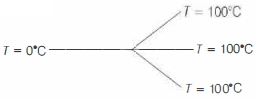
A metallic prong consists of $4$ rods made of the same material, cross-sections and same lengths as shown below. The three forked ends are kept at $100^{\circ} C$ and the handle end is at $0^{\circ} C$. The temperature of the junction is ............. $^{\circ} C$
A constant torque acting on a uniform circular wheel changes its angular momentum from $A_0$ to $4A_0$ in $4\, second$. The magnitude of this toque is
The mean kinetic energy of a gas at $300\, K$ is $100\, J.$ The mean energy of the gas at $450\, K$ is equal to ...... $J$
Two bodies $A$ and $B$ having equal surface areas are maintained at temperatures $10^\circ C$ and $20^\circ C$. The thermal radiation emitted in a given time by $A$ and $B$ are in the ratio:
A physical parameter a can be determined by measuring the parameters $b, c, d $ and $e $ using the relation $a =$ ${b^\alpha }{c^\beta }/{d^\gamma }{e^\delta }$. If the maximum errors in the measurement of $b, c, d$ and e are ${b_1}\%$, ${c_1}\%$, ${d_1}\%$ and ${e_1}\%$, then the maximum error in the value of a determined by the experiment is
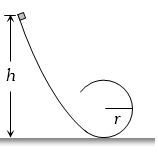
A block follows the path as shown in the figure from height $h$. If radius of circular path is $r$, then relation that holds good to complete full circle is
A particle is moving in a circle
A convex lens is made of a material having refractive index $1.2.$ Both the surfaces of the lens are convex. If it is dipped into water $(\mu=1.33),$ it will behave like:
A $0.5\ kg$ mass of lead is submerged in a container filled to the brim with water and a block of wood floats on top. The lead mass is slowly lifted from the container by a thin wire and as it emerges into air the level of the water in the container drops a bit. The lead mass is now placed on the block of wood. As the lead is placed on the wood.