MCQ
The solubility of $AgCl$ is minimum in
  • A
    $AgNO_3\,(0.1\,M)$
  • $H_2O\,(l)$
  • C
    $NaCl\,(0.4\,M)$
  • D
    $BaCl_2\,(0.3\,M)$

Answer

Correct option: B.
$H_2O\,(l)$
b
Due to common ion /rea$^n$ will proceed in backward direction that why solubility is decreases in the presence of common ion.
Concentration of common ion increases, solubility decreases. Max$^n$ common ion is obtained from $BaCl_2$

$\mathop {BaC{l_2}}\limits_{0.3}  \to B{a^{2 + }} + \mathop {2C{l^ - }}\limits_{0.6\,M} $

$\mathop {AgN{O_3}}\limits_{0.1}  \to A{g^ + } + \mathop {NO_3^ - }\limits_{0.1} $

$\mathop {NaCl}\limits_{0.4}  \to N{a^ + } + \mathop {C{l^ - }}\limits_{0.4} $

Need a full question paper?

Generate a complete, print-ready paper with questions like this in minutes — across 16+ boards, with answer keys.

Start Generating Free

Similar questions

Which of the underlined atoms in the molecules shown below have $sp-$ hybridization?

$\begin{array}{*{20}{l}}
  {(u){H_2}\underset{\raise0.3em\hbox{$\smash{\scriptscriptstyle-}$}}{C} CHC{H_3}{\mkern 1mu} {\mkern 1mu} {\mkern 1mu} {\mkern 1mu} (v){\mkern 1mu} C{H_2}\underset{\raise0.3em\hbox{$\smash{\scriptscriptstyle-}$}}{C} CHCl{\mkern 1mu} {\mkern 1mu} {\mkern 1mu} {\mkern 1mu} (w){\mkern 1mu} C{H_3}\underset{\raise0.3em\hbox{$\smash{\scriptscriptstyle-}$}}{C} H_2^ + {\mkern 1mu} {\mkern 1mu} {\mkern 1mu} (x){\mkern 1mu} H - C \equiv C - H} \\ 
  {(y){\mkern 1mu} C{H_3}\underset{\raise0.3em\hbox{$\smash{\scriptscriptstyle-}$}}{C} N{\mkern 1mu} {\mkern 1mu} {\mkern 1mu} {\mkern 1mu} (z){\mkern 1mu} {{(C{H_3})}_2}C\underset{\raise0.3em\hbox{$\smash{\scriptscriptstyle-}$}}{N} N{H_2}} 
\end{array}$
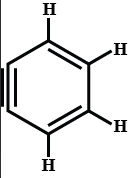
Resonance structures can be written for
$2\,g$ of oxygen contains number of atoms equal to that in
How many $ml$ of $1 \,(M)$ ${H_2}S{O_4}$ is required to neutralise $10\, ml$ of $1 \,(M) $ $NaOH$ solution
Which of the following salts on dissolution in water gives $pH$ less than $7$ at $298\, K $?
How many $sp^ 2$ and $sp-$ hybridised carbon atoms are present respectively in the following compound?
Total number of stereoisomers of the $1,3$ -dichlorocyclohexane is
At $298\, \mathrm{~K}$, the enthalpy of fusion of a solid $(\mathrm{X})$ is $2.8 \,\mathrm{k} \mathrm{J}\, \mathrm{mol}^{-1}$ and the enthalpy of vaporisation of the liquid $(X)$ is $98.2 \,\mathrm{~kJ}\, \mathrm{~mol}^{-1}$. The enthalpy of sublimation of the substance $(\mathrm{X})$ in $\mathrm{kJ} \,\mathrm{mol}^{-1}$ is $.....$ (in nearest integer)
The statement that is true for the long form of the periodic table is
The reaction of calcium with water is represented by the equation $Ca + 2H_2O \to  Ca(OH)_2 + H_2$ What volume of $H_2$ at $STP$ would be liberated when $8\, gm$ of calcium completely reacts with water? .......... $\mathrm{cm}^{-3}$