MCQ
The solubility of $CO_2$ in water increases with
  • A
    Increase in temperature
  • B
    Reduction of gas pressure
  • C
    Increase in gas pressure
  • Increase in volume

Answer

Correct option: D.
Increase in volume
d
According to Henry law

$\frac {P_1}{P_2}\,=\,\frac {S_1}{S_2}$

$\frac {500}{750}\,=\,\frac {0.01}{S_2}$

$\therefore $ $=\,\frac {750\times 0.01}{500}$ $=\,0.015\,g/L$

Need a full question paper?

Generate a complete, print-ready paper with questions like this in minutes — across 16+ boards, with answer keys.

Start Generating Free

Similar questions

$1.46 \,\mathrm{~g}$ of a biopolymer dissolved in a $100\, \mathrm{~mL}$ water at $300\, \mathrm{~K}$ exerted an osmotic pressure of $2.42 \times 10^{-3}$ $bar.$

The molar mass of the biopolymer is $.....\,\times 10^{4} \,\mathrm{~g}\,\mathrm{~mol}^{-1}$. (Round off to the Nearest Integer)

[Use : $\mathrm{R}=0.083\, \mathrm{~L}\, bar \,\mathrm{mol}^{-1} \,\mathrm{~K}^{-1}$ ]

Guanine is an example of:
$9.3 \mathrm{~g}$ of pure aniline upon diazotisation followed by coupling with phenol gives an orange dye. The mass of orange dye produced (assume $100$% yield/ conversion) is  . . . . . $g$. (nearest integer)
Which is the strongest base?
Identify the compound $C$ in the following sequence

$(CH_3)_2CHCH_2C  \equiv  N \xrightarrow{HCl,{{H}_{2}}O}$ compound $A \xrightarrow[2.\,{{H}_{2}}O]{1.\,LiAl{{H}_{4}}}$ compound $B \xrightarrow[C{{H}_{2}}C{{l}_{2}}]{PCC}$ compound $C$
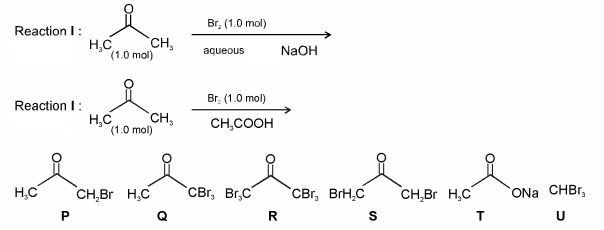
After completion of the reactions ($I$ and $II$ ), the organic compound$(s)$ in the reaction mixtures is (are)
Which of the following is $NOT$ a characteristic of the transition elements in the series from scandium to zinc?
Which of the following is not an essential part of an emulsion?
For a dilute solution containing $2.5\, g$ of a nonvolatile non-electrolyte solute in $100\, g$ of water, the elevation in boiling point at $1$ atm pressure is $2\,^oC$. Assuming  amount of solute is much lower than the amount of solvent, the vapour pressure ($mm$ of  $Hg$) of the solution is :- 

(take $K_b = 0.76\, K \,kg \,mol^{-1}$)

For a zero $-$ order reaction,