MCQ
The species having bond order different from that in $CO$  is
  • $NO^-$
  • B
    $NO^+$
  • C
    $CN^-$
  • D
    $N_2$

Answer

Correct option: A.
$NO^-$
a
$CO$ contains $14$ electrons ( $6$ from carbon and $8$ from oxygen).

$NO ^{-}$contains $16$ electrons ( $7$ from nitrogen, $8$ from oxygen, add $1$ more for negative charge).

$NO ^{+}$has $14$ electrons ( $7$ from nitrogen, $8$ from oxygen, subtract $1$ for positive charge).

$CN ^{-1}$ has $14$ electrons ( $7$ from nitrogen, $6$ from carbon, add $1$ more for negative charge).

$N _2$ has $14$ electrons ( $7$ from nitrogen each).

The species containing the same number of electrons have the same bond order.

So $NO ^{-}$is the only one which has bond order different. So option $A$ is correct.

Need a full question paper?

Generate a complete, print-ready paper with questions like this in minutes — across 16+ boards, with answer keys.
Start Generating Free

Similar questions

Three organic compounds $A , B$ and $C$ were allowed to run in thin layer chromatography using hexane and gave the following result (see figure). The $R_f$ value of the most polar compound is $............\,\times 10^{-2}$
Beryllium shows diagonal relationship with
Which reaction will occur at the fastest rate ?
In the given reaction

$C{H_3}C{H_2}CH = CHC{H_3}$ $\xrightarrow{X}C{H_3}C{H_2}COOH\, + \,C{H_3}COOH$

The $X$ is

For the reaction$C{H_3}COOH(l) + 2{O_2}(g)$ $\rightleftharpoons$ $2C{O_2}(g) + 2{H_2}O(l)$ at ${25\,^o}C$ and $1 \,atm$ . pressure, $\Delta H = - 874\,kJ.$ Then the change in internal energy $(\Delta E)$ is ….$kJ$
Which of the following involves transfer of five electrons ?
Choose the correct order of stability of carbocation using the concept of hyperconjugation.
$\begin{matrix}{\ \ \ \ \ \ \ \ \ \ \ \ \text{CH}_3\\ \ \ \ \ \ \ \ \ \ \ \ \ \ |\\\text{CH}_3-\text{C}^\oplus\\ \ \ \ \ \ \ \ \ \ \ \ \ \ |\\\ \ \ \ \ \ \ \ \ \ \ \ \text{CH}_3} & { \ \ \ \ \ \ \ \ \ \ \ \ \text{CH}_3\\ \ \ \ \ \ \ \ \ \ \ \ \ \ |\\\text{CH}_3-\text{C}^\oplus\\ \ \ \ \ \ \ \ \ \ \ \ \ \ |\\ \ \ \ \ \ \ \ \ \ \ \ \ \text{H} } & {\text{CH}_3\stackrel{{\oplus} }{\hbox{CH}_2}} & \stackrel{{\oplus} }{\hbox{CH}_3} \\ \ \ \ \ \ \ \ \ \text{I} & \ \ \ \ \ \ \ \text{II} & \ \ \text{III} & \text{IV} \end{matrix}$
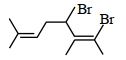
Total number of stereo isomers possible for the given structure:

$Image$

When $50\,c{m^3}$ of a strong acid is added to $50\,c{m^3}$ of an alkali, the temperature rises by ${5\,^o}C$. If $250\,c{m^3}$ of each liquid are mixed, the temperature rise would be.....$^oC$
For a dimerization reaction,

$2 A ( g ) \rightarrow A _{2}( g )$

at $298\, K , \Delta U^ \ominus,=-20\, kJ\, mol ^{-1}, \Delta S \odot=-30\, J$$K ^{-1}\, mol ^{-1},$ then the $\Delta G ^{\ominus}$ will be........$J$