Question
The specific heat of a gas in a polytropic process is given by

Answer

(c)

$\because C=C_V+\frac{R}{1-N}=\frac{R}{\gamma-1}-\frac{R}{N-1}$

Need a full question paper?

Generate a complete, print-ready paper with questions like this in minutes — across 16+ boards, with answer keys.
Start Generating Free

Similar questions

A sample of gas at temperature $\mathrm{T}$ is adiabatically expanded to double its volume. Adiabatic constant for the gas is $\gamma=3 / 2$. The work done by the gas in the process is : $(\mu=1 \mathrm{~mole})$
A monkey of mass $40 \,kg$ climbs up a rope, of breaking load $600 \,N$ hanging from a ceiling. If it climbs up the rope with the maximum possible acceleration, then the time taken by monkey to climb up is .........$s$ [Length of rope is $10 \,m$ ]
A rigid horizontal smooth rod AB of mass 0.75 kg and length 40 cm can rotate freely about a fixed vertical axis through its mid-point O. Two rings each of mass 1 kg initially at rest at a distance of 10 cm from O on either side of the rod. The rod is set in rotation with an angular velocity of 30 radian per sec and when the rings reach the ends of the rod, the angular velocity (in rad/sec) is:
In a semiconductor
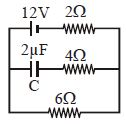
Find the charge on the capacitor $C$ in the following circuit ............ $\mu C$
What happens to fringe width in Young’s double slit experiment if it is performed in glycerine instead of air
While capturing solar energy for commercial purposes we use
A body $A$ moves with a uniform acceleration $a$ and zero initial velocity. Another body $B$, starts from the same point moves in the same direction with a constant velocity $v$. The two bodies meet after a time $t$. The value of $t$ is
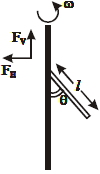
A uniform rod of length $'l'$ is pivoted at one of its ends on a vertical shaft of negligible radius When the shaft rotates at angular speed $\omega$ the rod makes an angle $\theta$ with it (see figure). To find $\theta$ equate the rate of change of angular momentum (direction going into the paper ) $\frac{ m \ell^{2}}{12} \omega^{2} \sin \theta \cos \theta$ about the centre of mass $(CM)$ to the torque provided by the horizontal and vertical forces $F_{H}$ and $F_{V}$ about the CM. The value of $\theta$ is then such that:
Which one of the following reactions does not represent correct combination of substrate and product under the given conditions?