MCQ
The specific heat of isothermal process is
  • A
    $0$
  • $\infty $
  • C
    $\frac{3}{2}\,R$
  • D
    $\frac{5}{2}\,R$

Answer

Correct option: B.
$\infty $
b
Given the process is isothermal which means it's temperature won't increase.

$C _p=\frac{\Delta Q }{ n \Delta T }$

Therefore specific heat will be infinity, as it is defined as heat supplied per unit increase in temperature.

Need a full question paper?

Generate a complete, print-ready paper with questions like this in minutes — across 16+ boards, with answer keys.
Start Generating Free

Similar questions

Between the plates of a parallel plate condenser there is $1\,mm$ thick paper of dielectric constant $4$. It is charged at $100\;volt$. The electric field in $volt/metre$ between the plates of the capacitor is
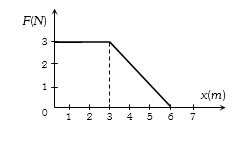
A force $F$ acting on an object varies with distance $x$as shown here. The force is in newton and $x$ in metre. The work done by the force in moving the object from $x = 0$to $x = 6\,m$ is......$J$
In a system two particles of masses $m_1=3 \mathrm{~kg}$ and $\mathrm{m}_2=2 \mathrm{~kg}$ are placed at certain distance from each other. The particle of mass $m_1$ is moved towards the center of mass of the system through a distance $2 \mathrm{~cm}$. In order to keep the center of mass of the system at the original position, the particle of mass $\mathrm{m}_2$ should move towards the center of mass by the distance_______.$\mathrm{cm}$.
The binding energy of nucleons in a nucleus can be affected by the pairwise Coulomb repulsion. Assume that all nucleons are uniformly distributed inside the nucleus. Let the binding energy of a proton be $E_b^p$ and the binding energy of a neutron be $E_b^n$ in the nucleus.

Which of the following statement($s$) is(are) correct?

$(A)$ $E_b^p-E_b^n$ is proportional to $Z(Z-1)$ where $Z$ is the atomic number of the nucleus.

$(B)$ $E_b^p-E_b^n$ is proportional to $A^{-\frac{1}{3}}$ where $A$ is the mass number of the nucleus.

$(C)$ $E_b^p-E_b^n$ is positive.

$(D)$ $E_b^p$ increases if the nucleus undergoes a beta decay emitting a positron.
Two discs have moments of intertia ${I}_{1}$ and ${I}_{2}$ about their respective axes perpendicular to the plane and passing through the centre. They are rotating with angular speeds, $\omega_{1}$ and $\omega_{2}$ respectively and are brought into contact face to face with their axes of rotation coaxial. The loss in kinetic energy of the system in the process is given by :
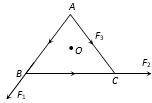
$ABC$ is an equilateral triangle with $O$ as its centre. $\vec F_1, \vec F_2 $and $\vec F_3$ represent three forces acting along the sides $AB, BC$ and $AC$ respectively. If the total torque about $O$ is zero then the magnitude of  $\vec F_3$ is
A straight wire of finite length carrying current $l$ subtends an angle of $60^{\circ}$ at point $P$ as shown. The magnetic field at $P$ is
A wedge of mass $M = 4\,m$ lies on a frictionless plane. A particle of mass $m$ approaches the wedge with speed $v$. There is no friction between the particle and the plane or between the particle and the wedge. The maximum height climbed by the particle on the wedge is given by
Two light beams of intensities $4\,I$ and $9\,I$ interfere on a screen. The phase difference between these beams on the screen at point $A$ is $zero$ and at point $B$ is $\pi$. The difference of resultant intensities, at the point $A$ and $B$, will be $....I$.
A projectile is thrown with some initial velocity at an angle $\alpha$ to the horizontal. Its velocity when it is at the highest point is $(2 / 5)^{1 / 2}$ times the velocity when it is at height half of the maximum height. Find the angle of projection $\alpha$ with the horizontal.