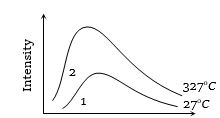
The spectrum of a black body at two temperatures $27^oC$ and $327^oC$ is shown in the figure. Let $A_1$ and $A_2$ be the areas under the two curves respectively. The value of $\frac{{{A_2}}}{{{A_1}}}$ is
Medium


Download our appand get started for free
Experience the future of education. Simply download our apps or reach out to us for more information. Let's shape the future of learning together!No signup needed.*
Similar Questions
- 1View SolutionNewton's law of cooling is used in laboratory for the determination of the
- 2Calculate radiation power for sphere whose temperature is $227^{\circ} C$ and radius $2\, m$ and emissivity $0.8$ (in $W$)View Solution
- 3The temperature of a piece of iron is ${27^o}C$ and it is radiating energy at the rate of $Q\;kW{m^{ - 2}}$. If its temperature is raised to ${151^o}C$, the rate of radiation of energy will become approximately ....... $Q\,kW\,{m^{ - 2}}$View Solution
- 4$Assertion :$ Two thin blankets put together are warmer than a single blanket of double the thickness.View Solution
$Reason :$ Thickness increases because of air layer enclosed between the two blankets. - 5A long metallic bar is carrying heat from one of its ends to the other end under steady-state. The variation of temperature $\theta$ along the length $x$ of the bar from its hot end is best described by which of the following figures?View Solution
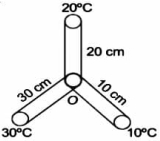
- 6Three rods of same material, same area of crosssection but different lengths $10 \,cm , 20 \,cm$ and $30 \,cm$ are connected at a point as shown. What is temperature of junction $O$ is ......... $^{\circ} C$View Solution
- 7Many exoplanets have been discovered by the transit method, where in one monitors, a dip in the intensity of the parent star as the exoplanet moves in front of it. The exoplanet has a radius $R$ and the parent star has radius $100 \,R$. If $I_0$ is the intensity observed on earth due to the parent star, then as the exoplanet transitsView Solution
- 8Two rods of same material have same length and area. The heat $\Delta Q$ flows through them for $12\,minutes$ when they are jointed in series. If now both the rods are joined in parallel, then the same amount of heat $\Delta Q$ will flow in ........ $\min$View Solution
- 9A solid copper cube of edges $1\;cm$ is suspended in an evacuated enclosure. Its temperature is found to fall from ${100^o}C$ to ${99^o}C$ in $100\;s$. Another solid copper cube of edges $2\;cm$, with similar surface nature, is suspended in a similar manner. The time required for this cube to cool from ${100^o}C$ to ${99^o}C$ will be approximately ...... $\sec$View Solution
- 10A cane is taken out from a refrigerator at $0°C$ . The atmospheric temperature is $25°C$ . If $t_1$ is the time taken to heat from $0°C$ to $5°C$ and $t_2$ is the time taken from $10°C$ to $15°C$, thenView Solution