The speed of a wave in a medium is $760\, m/s$. If $3600 $ waves are passing through a point, in the medium in $2$ minutes, then its wavelength is ...... $m$
Easy


Download our appand get started for free
Experience the future of education. Simply download our apps or reach out to us for more information. Let's shape the future of learning together!No signup needed.*
Similar Questions
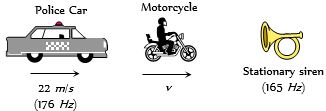
- 1A police car moving at $22 m/s$, chases a motorcyclist. The police man sounds his horn at $176 Hz$, while both of them move towards a stationary siren of frequency $165 Hz$. Calculate the speed of the motorcycle, if it is given that he does not observes any beats .... $m/s$View Solution
- 2Two waves are propagating to the point $P$ along a straight line produced by two sources $A$ and $B$ of simple harmonic and of equal frequency. The amplitude of every wave at $P$ is $‘a’$ and the phase of $A$ is ahead by $\frac{\pi }{3}$ than that of $B$ and the distance $AP$ is greater than $BP$ by $50 cm.$ Then the resultant amplitude at the point $P$ will be, if the wavelength is $1$ meterView Solution
- 3A plane progressive wave is given by $y=2 \cos 2 \pi(330 t-x) m$. The frequency of the wave is:View Solution
- 4Two waves are represented byView Solution
$y_1=5 \sin 2 \pi(75 t-0.25 x)$
$y_2=10 \sin 2 \pi(150 t-0.50 x)$
The intensity ratio $\frac{I_1}{I_2}$ of the two waves is
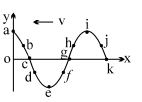
- 5The figure represents the instantaneous picture of a longitudinal harmonic wave travelling along the negative $x$-axis. Identify the correct statement $(s)$ related to the movement of the points shown in the figure. The stationary points areView Solution
- 6A granite rod of $60\ cm$ length is clamped at its middle point and is set into longitudinal vibrations. The density of granite is $2.7 \times 10^3 $ $kg/m^3$ and its Young's modulus is $9.27 \times 10^{10}$ $Pa$ What will be the fundamental frequency of the longitudinal vibrations .... $kHz$ ?View Solution
- 7A sine wave has an amplitude $A$ and wavelength $\lambda$. Let $V$ be the wave velocity and $v$ be the maximum velocity of a particle in the medium. ThenView Solution
- 8View SolutionApparatus used to find out the velocity of sound in gas is
- 9When two tuning forks (fork $1$ and fork $2$) are sounded simultaneously, $4$ beats per second are heard. Now, some tape is attached on the prong of the fork $2$. When the tuning forks are sounded again, $6$ beats per second are heard. If the frequency of fork $1$ is $200\, Hz$, then what was the original frequency of fork $2$? .... $Hz$View Solution
- 10$50$ tuning forks are arranged in increasing order of their frequencies such that each gives $4 \,beats/sec$ with its previous tuning fork. If the frequency of the last fork is octave of the first, then the frequency of the first tuning fork is ... $Hz$View Solution