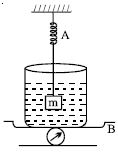
The spring balance $A$ reads $2$ $kg$ with a block $m $ suspended from it. $A$ balance $B$ reads $5$ $kg$ when a beaker with liquid is put on the pan of the balance. The two balances are now so arranged that the hanging mass is inside the liquid in the beaker as shown in the figure in this situation:
Diffcult
Download our app for free and get started
Balance $A$ will read less than $2 \mathrm{kg}$ as an upward buoyant force is acting on the block. Balance $B$ will read more than $5\, kg$ as downward reaction of the block due to buoyant force is acting on beaker.

Download our appand get started for free
Experience the future of education. Simply download our apps or reach out to us for more information. Let's shape the future of learning together!No signup needed.*
Similar Questions
- 1A cubical block of side $0.5\,m$ floats on water with $30\%$ of its volume under water. ....... $kg$ is the maximum weight that can be put on the block without fully submerging it under water ? [Take density of water $= 10^3\,kg/m^3$ ]View Solution
- 2The velocity of water in a river is $18\, km/h$ near the surface. If the river is $5\, m$ deep, find the shearing stress between the horizontal layers of water. The co-efficient of viscosity of water $= 10^{-2}\,,poise$View Solution
- 3A piece of gold weighs $10 \,g$ in air and $9 \,g$ in water. What is the volume of cavity is $...... cc ($Density of gold $=19.3 \,g \ cm ^{-3} )$View Solution
- 4A metal ball of density $7800\ kg/m^3$ is suspected to have a large number of cavities . It weighs $9.8$ $kg$ when weighed directly on a balance and $1.5$ $kg$ less when immersed in water . The fraction by volume of the cavities in the metal ball is approximately ....... $\%$View Solution
- 5The top of a water tank is open to air and its water level is maintained. It is giving out $0.74\,m^3$ water per minute through a circular opening of $2\,cm$ radius in its wall. The depth of the centre of the opening from the level of water in the tank is close to........ $m$View Solution
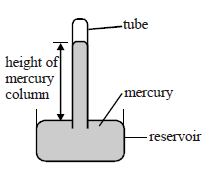
- 6View SolutionThe diagram shows a simple mercury barometer.Which of the following does not cause the height of the mercury column to vary ?
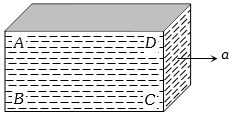
- 7A closed rectangular tank is completely filled with water and is accelerated horizontally with an acceleration a towards right. Pressure is $(i)$ maximum at, and $ (ii) $ minimum atView Solution
- 8Two drops of same radius are falling through air with steady velocity of $v $ $cm/s$. If the two drops coalesce, what would be the terminal velocity?View Solution
- 9The density of ice is $0.9 \,g / cm ^3$. What percentage by volume of the block of ice floats outside the water is ..........$\%$View Solution
- 10In an experiment, a small steel ball falls through a Iiquid at a constant speed of $10\, cm/s$. If the steel ball is pulled upward with a force equal to twice its effective weight, how fast will it move upward ? ......... $cm/s$View Solution