MCQ
The square root of 64 divided by the cube root of 64 is:
  • A
    $64$
  • B
    $2$
  • C
    $\frac{1}{2}$
  • D
    $64^\frac{2}{3}$

Answer

  1. $2$
    Solution:
    We have to find the value of $\frac{\sqrt[2]{64}}{\sqrt[3]{64}}.$
    So,
    $\frac{\sqrt[2]{64}}{\sqrt[3]{64}}=\frac{\sqrt[2]{2\times2\times2\times2\times2\times2}}{\sqrt[2]{2\times2\times2\times2\times2\times2}}$
    $=\frac{2^{6\times\frac{1}{2}}}{2^{6\times\frac{1}{3}}}$
    $=\frac{\sqrt[2]{64}}{\sqrt[3]{64}}=\frac{2^3}{2^2}$
    $=2^{3-2}$
    $=2^1$
    $=2$
    The value of $\frac{\sqrt[2]{64}}{\sqrt[3]{64}}$ is 2
    Hence the correct choice is b.

Need a full question paper?

Generate a complete, print-ready paper with questions like this in minutes — across 16+ boards, with answer keys.
Start Generating Free

Similar questions

The value of $0 . \overline{23}+0 . \overline{22}$ is
How many triangles can be drawn having angles as 45º, 60º and 85º?
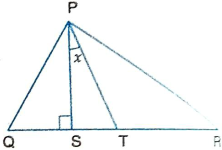
In Fig , if $P T$ is the bisector of $\angle Q P R$ in $\triangle P Q R, \angle P Q R=50^{\circ}, \angle P R Q=30^{\circ}$ and $P S \perp Q R$, then $x=$
Image
Is quad. ABCD a parallelogram?
  1. Its opposite sides are equal.
  2. Its opposite angles are equal.
  1. If the question can be answered by one of the given statements alone and not by the other;
  2. If the question can be answered by either statement alone;
  3. If the question can be answered by both the statements together but not by any one of the two;
  4. If the question cannot be answered by using both the statements together.
The area of the floor of a room is 15m2. If its height is 4m, them the volume of the air contained in the room is:
  1. 60dm3
  2. 600dm3
  3. 6000dm3
  4. 60000dm3
If $\text{p}(\text{x})=\text{x}^2-2\sqrt2\text{x}+1$ then $\text{p}(2\sqrt2)=?$
If $\bar{\text{x}}_1, \bar{\text{x}}_2, \bar{\text{x}}_3, ....., \bar{\text{x}}_\text{n}$ are the means of n group with n1, n2, ...., nn number of observations respectively, then the mean $\bar{\text{x}}$ of all the groups taken together is given by:
  1. $\sum\limits^\text{n}_{\text{i}=1}$
  2. $\frac{\sum\limits^\text{n}_{\text{i}=1}\text{n}_\text{i}\bar{\text{x}}_\text{i}}{\text{n}^2}$
  3. $\frac{\sum\limits^\text{n}_{\text{i}=1}\text{n}_\text{i}\bar{\text{x}}_\text{i}}{\text{n}_2}$
  4. $\frac{\sum\limits^\text{n}_{\text{i}=1}\text{n}_\text{i}\bar{\text{x}}_\text{i}}{2\text{n}}$
The value of $\frac{(0.013)^3+(0.007)^3}{(0.013)^2-0.013 \times 0.007+(0.007)^2}$, is
Given​​ $\angle\text{POR}=3\text{x}$ and​​ $\angle\text{QOR}=2\text{x}+10^\circ.$ If ​​$\angle\text{POQ}$ is a straight line, then the value of x is: