MCQ
The stabilisation of coordination compounds due to chelation is called the chelate effect. Which of the following is the most stable complex species?
  • A
    [Fe(CO)5]
  • B
    [Fe(CN)6]3–
  • C
    [Fe(C2O4)3]3–
  • D
    [Fe(H2O)6]3+

Answer

  1. [Fe(C2O4)3]3–

Explanation:

Chelation (formation of cycle by linkage between metal ion and ligand) stabilizes the coordination compound. The ligand which chelates the metal ion are known as chelating ligand.
Here, only [Fe(C2O4)3]3- is a coordination compound which contains oxalate ion as a chelating ligand. Hence, it stabilizes coordination compound by chelating Fe3+ ion.

Need a full question paper?

Generate a complete, print-ready paper with questions like this in minutes — across 16+ boards, with answer keys.

Start Generating Free

Similar questions

An organic compound $\mathrm{A}\left(\mathrm{C}_{6} \mathrm{H}_{6} \mathrm{O}\right)$ gives dark green colouration with ferric chloride. On treatment with $\mathrm{CHCl}_{3}$ and $\mathrm{KOH}$, followed by acidification gives compound $\mathrm{B}$. Compound $B$ can also be obtained from compound $\mathrm{C}$ on reaction with pyridinium chlorochromate $(PCC).$ Identify $A, B$ and $C.$
Resistance of a conductivity cell (cell constant $129 \;m ^{-1}$ ) filled with $74.5\; ppm$ solution of $KCl$ is $100\; \Omega$ (labelled as solution 1). When the same cell is filled with $KCl$ solution of $149 \;ppm$, the resistance is $50\; \Omega$ (labelled as solution 2). The ratio of molar conductivity of solution $1$ and solution $2$ is i.e. $\frac{\wedge_{1}}{\wedge_{2}}=x \times 10^{-3}$. The value of $x$ is

(Nearest integer)

Given, molar mass of $KCl$ is $74.5 g mol ^{-1}$

Transitional elements are
Which of the following reactant in reactions can reduced by $SO_2$

$(I)\,\, O_3 \to $ product

$(II)\,\,C{r_2}O_7^{ - 2}\xrightarrow{{{H^ + }}}$ product

$(III)\,\,MnO_4^\Theta \xrightarrow{{{H^ + }}}$ product

$(IV)\,\, H_2S \to $ product
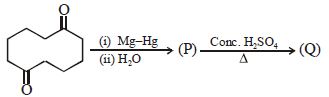
Major product $(Q)$ of following reaction is :
When an inorganic compound reacts with $SO_2$ in aqueous medium, produces $(A).$ $(A)$ on reaction with $Na_2CO_3,$ gives compound $(B)$ which with sulphur, gives a substance $(C)$ used in photography. Compound $(C)$ is
The pair(s) of complexes wherein both exhibit tetrahedral geometry is(are)

Note: py $=$ pyridine

Given: Atomic numbers of $Fe , Co , Ni$ and $Cu$ are $26,27,28$ and $29$ , respectively)

$(A)$ $\left[ FeCl _4\right]^{-}$and $\left[ Fe ( CO )_4\right]^{2-}$

$(B)$ $\left[ Co ( CO )_4\right]^{-}$and $\left[ CoCl _4\right]^{2-}$

$(C)$ $\left[ Ni ( CO )_4\right]$ and $\left[ Ni ( CN )_4\right]^{2-}$

$(D)$ $\left[ Cu ( py )_4\right]^{+}$and $\left[ Cu ( CN )_4\right]^{3-}$
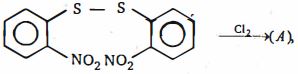
Number of $P - O$ bonds in ${P_4}{O_{10}}$ is
Product $(A)$ of this reaction is
The rate constant of a first order reaction whose half-life is $ 480\,\sec$ , is