MCQ
The standard electrode potential $({E^o})$ for $OC{l^ - }/C{l^ - }$ and $C{l^ - }/\frac{1}{2}C{l_2}$ respectively are $0.94\,V$ and $ - 1.36\,V$. The ${E^o}$ value for $OC{l^ - }/\frac{1}{2}C{l_2}$ will be ............... $\mathrm{V}$
  • $ - 0.42$
  • B
    $ - 2.20$
  • C
    $0.52$
  • D
    $1.04$

Answer

Correct option: A.
$ - 0.42$
a
(a)$OC{l^ - } \to {C^ - },\,{E^o} = 0.94\,V$

$C{l^ - } \to \frac{1}{2}C{l_2} + {e^ - }{E^o} = - 1.36\,V$

adding the two equations, we get

$OC{l^ - } \to \frac{1}{2}C{l_2},\,{E^o} = 0.94 - 1.36 = - 0.42\,V$.

Need a full question paper?

Generate a complete, print-ready paper with questions like this in minutes — across 16+ boards, with answer keys.

Start Generating Free

Similar questions

$20\, ml$ solution contains $0.1\, M, NH_4Cl$ and $0.01\, M\, NH_4OH$. By adding which one its $pH$ will not change ?
$\begin{matrix}
   \,\,\,Br\,\,\,\,\,\,\,\,\,\,\,\,\,\,\,\,\,\,\,\,\,\,\,\,\,\,\,\,\,\,\,\,\,\,\,\,\,\,\,\,\,\,\,\,\,\,\,Br\,\,\,\,\,\,\,\,\,\,\,\,\,\,\,\,\,\,\,\,\,\,\,\,\,\,\,\,\,\,\,\,\,\,\,\,\,\,\,\,  \\
   \,\,\,|\,\,\,\,\,\,\,\,\,\,\,\,\,\,\,\,\,\,\,\,\,\,\,\,\,\,\,\,\,\,\,\,\,\,\,\,\,\,\,\,\,\,\,\,\,\,\,\,\,\,\,\,|\,\,\,\,\,\,\,\,\,\,\,\,\,\,\,\,\,\,\,\,\,\,\,\,\,\,\,\,\,\,\,\,\,\,\,\,\,\,\,\,\,\,\,  \\
   C{{H}_{2}}-CH=CH-C{{H}_{2}}\xrightarrow{Zn\,(dust)}(A)  \\
\end{matrix}$

Above reaction is an example of $1,4$ -elimination. Predict the product.

A solution at $20\,^oC$ is composed of  $1.5\,mol$ of benzene and $3.5\,mol$ of toluene. If the vapour pressure of pure benzene and pure toluene at this temperature are $74.7\,torr$ and $22 .3\, torr,$ respectively, then the total vapour pressure of the solution and the benzene mole fraction in equilibrium with it will be, respectively
Pure conc. $HN{O_3}$makes iron passive as the surface is covered with protective layer of
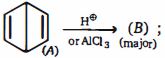
$(A)$ & $(B)$ are isomers. Product $(B)$ is :Dewar's Benzene
Tautomerism is exhibited by
Aspirin can be prepared by the reaction of
$N{a^ + }$ion is isoelectronic with
The reason for "drug induced poisoning" is
In the given reaction

$X + Y\mathop {\xrightarrow{{NaOH}}}\limits_{5\,^oC} \begin{array}{*{20}{c}}
  {OH\,\,\,\,\,\,\,\,\,\,\,\,\,\,\,\,\,\,\,} \\ 
  {|\,\,\,\,\,\,\,\,\,\,\,\,\,\,\,\,\,\,\,\,\,\,\,\,\,} \\ 
  {C{H_3} - CH - CH - CHO} \\ 
  {\,\,\,\,\,\,\,\,\,|} \\ 
  {\,\,\,\,\,\,\,\,\,\,\,\,\,\,\,\,\,C{H_3}} 
\end{array}$

$(X)$ and $(Y)$ will respectively be :