MCQ
The state of a thermodynamic system is represented by
  • A
    Pressure only
  • B
    Volume only
  • Pressure, volume and temperature
  • D
    Number of moles

Answer

Correct option: C.
Pressure, volume and temperature
c
(c) The state of a system is defined by ascribing values to a sufficient number of variables. In mechanics, the state of a body is specified by means of a few measurable quantities, such as the position of centre of mass, its velocity and acceleration etc. In thermodynamics, however we disregard these mechanical coordinates and instead consider the interior of the system, find out directly or indirectly by experiments same measurable quantities upon which the internal state of the system for all thermodynamic purposes, the state of a system can be represented by specifying its pressure $p,$ volume $v$ and the temperature $T$ provided the system is in equilibrium.

Need a full question paper?

Generate a complete, print-ready paper with questions like this in minutes — across 16+ boards, with answer keys.

Start Generating Free

Similar questions

A uniform cable of mass $‘M’$ and length $‘L’$ is placed on a horizontal surface such that its ${\left( {\frac{1}{n}} \right)^{th}}$  part is hanging below the edge of the surface. To lift the hanging part of the cable upto the surface, the work done should be
An ideal gas is enclosed in a cylinder at pressure of $2\,atm$ and temperature, $300\,K.$ The mean time between two successive collisions is $6 \times 10^{-8}\, s.$ If the pressure is doubled and temperature is increased to $500\,K,$ the mean time between two successive collisions will be close to
A ring of mass $M$ and radius $R$ is rotating about its axis with angular velocity $\omega $. Two identical bodies each of mass $m$ are now gently attached at the two ends of a diameter of the ring. Because of this, the kinetic energy loss will be
Two sine waves travel in the same direction in a medium. The amplitude of each wave is A and the phase difference between the two waves is 120°. The resultant amplitude will be:
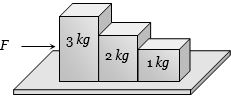
Consider the following statements about the blocks shown in the diagram that are being pushed by a constant force on a frictionless table

$A.$All blocks move with the same acceleration

$B.$The net force on each block is the same

Which of these statements are/is correct
Two trains one of length $100 \,m$ and another of length $125\, m$, are moving in mutually opposite directions along parallel lines, meet each other, each with speed $10$$m/s$. If their acceleration are $0.3$$m/{s^2}$ and $0.2$$m/{s^2}$ respectively, then the time they take to pass each other will be.........$s$
An object is placed in a medium of refractive index $3$. An electromagnetic wave of intensity $6 \times 10^8 \mathrm{~W} / \mathrm{m}^2$ falls normally on the object and it is absorbed completely. The radiation pressure on the object would be (speed of light in free space $=3 \times 10^8 \mathrm{~m} / \mathrm{s}$ ):
A football player throws a ball with a velocity of $50$ metre/sec at an angle $30 $ degrees from the horizontal. The ball remains in the air for  ...... $\sec$ $(g = 10\,m/{s^2})$
A constant torque acting on a uniform circular wheel changes its angular momentum from L to 4L in 4 seconds. The magnitude of this torque is:
Let $\overrightarrow C = \overrightarrow A  + \overrightarrow B$

$(A)$ It is possible to have $| \overrightarrow C | < | \overrightarrow A |$ and $ | \overrightarrow C | < | \overrightarrow B|$

$(B)$ $|\overrightarrow C |$  is always greater than $|\overrightarrow A |$

$(C)$ $|\overrightarrow C |$ may be equal to $|\overrightarrow A | + |\overrightarrow B|$

$(D)$ $|\overrightarrow C |$ is never equal to $|\overrightarrow A | + |\overrightarrow B|$

Which of the above is correct