MCQ
The stopping potential is directly related to:
- AThe work function of the metal.
- BIntensity of incident radiation.
- CThe saturation current for the given frequency.
- DThe kinetic energy gained by the photoelectrons.
Generate a complete, print-ready paper with questions like this in minutes — across 16+ boards, with answer keys.
In the context of Doppler effect in light, the term ‘red shift’ signifies
|
(a) Decrease in frequency |
(b) Increase in frequency |
|
(c) Decrease in intensity |
(d) Increase in intensity |
A thin rod of length f/3 lies along the axis of a concave mirror of focal length f. One end of its magnified image touches an end of the rod. The length of the image is
|
(a) f |
(b) |
(c) 2f |
(d) |
In the figure shown there are two semicircles of radii  and
and  in which a current i is flowing. The magnetic induction at the centre O will be

|
(a) |
(b) |
(c) |
(d) |
A ray of light incident at an angle θ on a refracting face of a prism emerges from the other face normally. If the angle of the prism is 5º and the prism is made of a material of refractive index 1.5, the angle of incidence is:
The current is flowing in south direction along a power line. The direction of magnetic field above the power line (neglecting earth's field) is
|
(a) South |
(b) East |
(c) North |
(d) West |
The de-Broglie wavelength of an electron in the first Bohr orbit is
|
(a) Equal to one fourth the circumference of the first orbit |
|
(b) Equal to half the circumference of the first orbit |
|
(c) Equal to twice the circumference of the first orbit |
|
(d) Equal to the circumference of the first orbit |
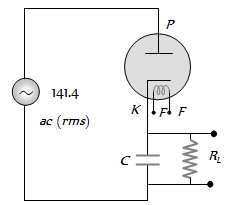
An alternating voltage of 141.4V (rms) is applied to a vacuum diode as shown in the figure. The maximum potential difference across the condenser will be
|
(a) 100 V |
(b) 200 V |
(c) 100 |
(d) 200 |


