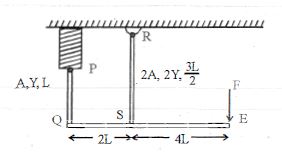
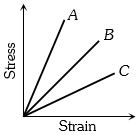
The stress-strain curves for brass, steel and rubber are shown in the figure. The lines $A, B$ and $C$ are for
Medium


Download our appand get started for free
Experience the future of education. Simply download our apps or reach out to us for more information. Let's shape the future of learning together!No signup needed.*
Similar Questions
- 1A steel wire is $1 \,m$ long and $1 \,mm ^2$ in area of cross$-$section. If it takes $200 \,N$ to stretch this wire by $1 \,mm$, how much force will be required to stretch a wire of the same material as well as diameter from its normal length of $10 \,m$ to a length of $1002 \,cm$ is $........ N$View Solution
- 2The work per unit volume to stretch the length by $1\%$ of a wire with cross sectional area of $1\,m{m^2}$ will be. $[Y = 9 \times {10^{11}}\,N/{m^2}]$View Solution
- 3The depth below the surface of sea to which a rubber ball be taken so as to decrease its volume by $0.02 \%$ is______ $\mathrm{m}$.View Solution
(Take density of sea water $=10^3 \mathrm{kgm}^{-3}$, Bulk modulus of rubber $=9 \times 10^8 \mathrm{Nm}^{-2}$, and $\mathrm{g}=10 \mathrm{~ms}^{-2}$ )
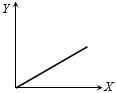
- 4A student plots a graph from his reading on the determination of Young’s modulus of a metal wire but forgets to label. The quantities on $X$ and $Y$ axes may be respectively.View Solution
- 5A cubical solid aluminium (bulk modulus $=-V \frac{ dP }{ dV }=70 GPa$ ) block has an edge length of $1 m$ on the surface of the earth. It is kept on the floor of a $5 km$ deep ocean. Taking the average density of water and the acceleration due to gravity to be $10^3 kg m ^{-3}$ and $10 ms ^{-2}$, respectively, the change in the edge length of the block in $mm$ is . . . . .View Solution
- 6In $CGS$ system, the Young's modulus of a steel wire is $2 \times {10^{12}}$. To double the length of a wire of unit cross-section area, the force required isView Solution
- 7A wire is stretched by $0.01$ $m$ by a certain force $F.$ Another wire of same material whose diameter and length are double to the original wire is stretched by the same force. Then its elongation will beView Solution
- 8A solid sphere of radius $r$ made of a soft material of bulk modulus $K$ is surrounded by a liquid in a cylindrical container. A massless piston of area $a$ floats on the surface of the liquid, covering entire crosssection of cylindrical container. When a mass $m$ is placed on the surface of the piston to compress the liquid, the fractional decrement in the radius of the sphere, $\left( {\frac{{dr}}{r}} \right)$ isView Solution
- 9A solid sphere of radius $R$ made of of material of bulk modulus $K$ is surrounded by a liquid in a cylindrical container. $A$ massless piston of area $A$ floats on the surface of the liquid. When a mass $m$ is placed on the piston to compress the liquid, the fractional change in the radius of the sphere $\delta R/R$ isView Solution
- 10A rigid massless rod of length $6\ L$ is suspended horizontally by means of two elasticrods $PQ$ and $RS$ as given figure. Their area of cross section, young's modulus and lengths are mentioned in figure. Find deflection of end $S$ in equilibrium state. Free end of rigid rod is pushed down by a constant force . $A$ is area of cross section, $Y$ is young's modulus of elasticityView Solution