- ✓$2\pi \sqrt {\frac{{2(M + 3m)\,L}}{{3(M + 2m)\,g}}} $
- B$2\pi \sqrt {\frac{{(M + 2m)\,L}}{{3(M + 3m)\,g}}} $
- C$2\pi \sqrt {\left( {\frac{{2M}}{{3m}}} \right)\,\frac{L}{g}} $
- D$2\pi \sqrt {\left( {\frac{{M + m}}{{M + 3m}}} \right)\,\frac{L}{g}} $
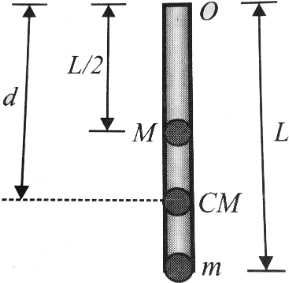
$T=2 \pi \sqrt{\frac{I_{0}}{M g d}}$ $...(i)$
$I_{0}=$ moment of inertia about of suspension
$=\frac{M L^{2}}{3}+m L^{2}=\frac{(M+3 m) L^{2}}{3}$
$M^{\prime}=$ total mass $=(M+m)$
$d=$ separation between point of suspension and centre of mass of the pendulum
$=\frac{M\left(\frac{L}{2}\right)+m(L)}{(M+m)}=\frac{(M+2 m) L}{2(M+m)}$
Substituting the values in Eq. $(i)$ we get
$\Rightarrow T=2 \pi \sqrt{\frac{2(M+3 m) L}{3(M+2 m) g}}$
Generate a complete, print-ready paper with questions like this in minutes — across 16+ boards, with answer keys.
Statement $I:$ Area under velocity- time graph gives the distance travelled by the body in a given time.
Statement $II:$ Area under acceleration- time graph is equal to the change in velocity- in the given time.
In the light of given statements, choose the correct answer from the options given below.