The string of a violin has a frequency of $440 \,cps$. If the violin string is shortened by one fifth, its frequency will be changed to ........... $cps$
Medium


Download our appand get started for free
Experience the future of education. Simply download our apps or reach out to us for more information. Let's shape the future of learning together!No signup needed.*
Similar Questions
- 1If wavelength of a wave is $\lambda = 6000Å.$ Then wave number will beView Solution
- 2A policeman on duty detects a drop of $10 \%$ in the pitch of the hom of motion of car as it crosses him. If the velocity of sound is $330 \,m / s$. Calculate the speed of the car ........... $m / s$View Solution
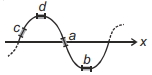
- 3Figure shows a snapshot for a travelling sine wave along a string. Four elemental portions $a, b, c$ and $d$ are indicated on the string. The elemental portion which has maximum potential energy is/areView Solution
- 4The equation of a wave on a string of linear mass density $0.04\, kgm^{-1}$ is given by : $y = 0.02\,\left( m \right)\,\sin \,\left[ {2\pi \left( {\frac{t}{{0.04\left( s \right)}} - \frac{x}{{0.50\left( m \right)}}} \right)} \right]$. The tension in the string is ..... $N$View Solution
- 5The time of reverberation of a room $A$ is one second. What will be the time (in seconds) of reverberation of a room, having all the dimensions double of those of room $A$View Solution
- 6A tuning fork of unknown frequency produoes $4$ beats per second when sounded with another tuning fork of frequency $254 \,Hz$. It gives the same number of beats per second when unknown tuning fork loaded with wax. The unknown frequency before loading with wax is ..........View Solution
- 7A car moves towards a hill with speed $v_c$. It blows a horn of frequency $f$ which is heared by an observer following the car with speed $v_0$. The speed of sound in air is $v$.View Solution
- 8A wire of density $8 \times 10^3\,kg / m ^3$ is stretched between two clamps $0.5\,m$ apart. The extension developed in the wire is $3.2 \times 10^{-4}\,m$. If $Y =8 \times 10^{10}\,N / m ^2$, the fundamental frequency of vibration in the wire will be $......\,Hz$.View Solution
- 9View SolutionAn organ pipe open at one end is vibrating in first overtone and is in resonance with another pipe open at both ends and vibrating in third harmonic. The ratio of length of two pipes is
- 10View SolutionA medium can carry a longitudinal wave because it has the property of