MCQ
The strongest of the four acids listed below is
  • A
    $HCOOH$
  • B
    $C{H_3}COOH$
  • C
    $ClC{H_2}COOH$
  • $FC{H_2}COOH$

Answer

Correct option: D.
$FC{H_2}COOH$
(d)Smaller the $_p{K_a}$ value, strong the acid.

Need a full question paper?

Generate a complete, print-ready paper with questions like this in minutes — across 16+ boards, with answer keys.

Start Generating Free

Similar questions

Which statement is true
The concentrated sulphuric acid that is peddled commercial is $95\%\,\,H_2SO_4$ by weight . If the density of this commercial acid is $1.834\,g\,cm^{-3},$ the molarity of this solution is ........... $\mathrm{M}$
Match List $I$ w1th List $II$

LIST $I$

(Precipitating reagent and

conditions)

LIST $II$

(Cation)

$A$ $\mathrm{NH}_4 \mathrm{Cl}+\mathrm{NH}_4 \mathrm{OH}$ $I$ $\mathrm{Mn}^{2+}$
$B$ $\mathrm{NH}_4 \mathrm{OH}+\mathrm{Na}_2 \mathrm{CO}_3$ $II$ $\mathrm{Pb}^{2+}$
$C$ $\mathrm{NH}_4 \mathrm{OH}+\mathrm{NH}_4 \mathrm{Cl}+\mathrm{H}_2 \mathrm{~S}$ gas $III$ $\mathrm{Al}^{3+}$
$D$ dilute $\mathrm{HCl}$ $IV$ $\mathrm{Sr}^{2+}$

Choose the correct answer from the options given below:

In the equilibrium reaction 

$AgCl(s) + 2N{H_3}(aq.) \rightleftharpoons Ag{(N{H_3})_2}^ + (aq) + C{l^ - }(aq.)$

Increase in the concentration of $Cl^-(aq.)$ causes
Which of the following cobalt $(III)$ complex is paramagnetic and high spin complex
Which molecule $AX_3$, $AX_4$, $AX_5$, $AX_6$ is most likely to have a trigonal bipyramidal structure if $A$ has no lone pair ?
The entropy change, in the conversion of one mole of liquid water at $373 \,K$ to vapour at the same temperature is (Latent heat of vaporization of water, $\Delta {H_{vap}} = 2.257\,kJ/g)$ ........$J\,{k^{ - 1}}$
The $pH$ of an aqueous solution containing $[{H^ + }] = 3 \times {10^{ - 3}}M$ is
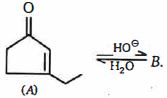
$(A)$ and $(B)$ are isomer : Identify $(B)$
Choose the correct tests with respective observations.
(A) $CuSO _4$ (acidified with acetic acid) + $K _4\left[ Fe ( CN )_6\right] \rightarrow$ Chocolate brown precipitate.
(B) $FeCl _3+ K _4\left[ Fe ( CN )_6\right] \rightarrow$ Prussian blue precipitate.
(C) $ZnCl _2+ K _4\left[ Fe ( CN )_6\right]$, neutralised with $NH _4 OH$ $\rightarrow$ White or bluish white precipitate.
(D) $MgCl _2+ K _4\left[ Fe ( CN )_6\right] \rightarrow$ Blue precipitate.
(E) $BaCl _2+ K _4\left[ Fe ( CN )_6\right]$, neutralised with NaOH $\rightarrow$ White precipitate.
Choose the correct answer from the options given below: