MCQ
The structure of diborane contains:
- ✓Four $2C-2e$ bonds and two $3C-2e$ bonds
- BTwo $2C-2e$ bonds and two $3C-2e$ bonds
- CTwo $2C-2e$ bonds and two $3C-3e$ bonds
- DFour $2C-2e$ bonds and two $3C-3e$ bonds
Four hydrogen are connected to $B$ atoms by covalent bonds. So there are four $2$ centered$- 2$ electron bonds
$2$ hydrogen atoms are connected by bridge and it is connected to $2$ boron atoms . So, there are $3$ -centred-$2$- electron bonds
$( H - B ) \rightarrow 2\quad C -2 e$ bonds
$(B-H-B) \rightarrow 3\quad C-2e$ bonds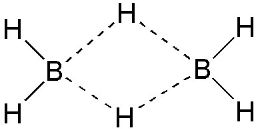
Generate a complete, print-ready paper with questions like this in minutes — across 16+ boards, with answer keys.
$U\,\,\, 1s^2 \,2s^2 \,2p^3$
$V\,\,\, 1s^2\,2s^2 \,2p^6 \,3s^1$
$W\,\,\, 1s^2\,2s^2\, 2p^6\,3s^2\,3p^2$
$X\,\,\, 1s^2\,2s^2\,2p^6\,3s^2\,3p^6\,3d^5\, 4s^2$
$Y\,\,\, 1s^2\, 2s^2\,2p^6\,3s^2\,3p^6\,3d^{10}\, 4s^2\, 4p^6$
Determine which sequence of elements satisfy the following statements :
$(i)$ Element forms a carbonate which is not decomposed by heating
$(ii)$ Element is most likely to form coloured ionic compounds
$(iii)$ Element has largest atomic radius
$(iv)$ Element forms only acidic oxide
(Assume $100\%$ ionization)
$A.$ $0.500\,M\,C _2 H _5 OH ( aq )$ and $0.25\, M\, KBr ( aq )$
$B.$ $0.100\,M\,K _4\left[ Fe ( CN )_6\right]$ (aq) and $0.100\, M$ $FeSO _4\left( NH _4\right)_2 SO _4$ (aq)
$C.$ $0.05 \,M\, K _4\left[ Fe ( CN )_6\right]( aq )$ and $0.25\, M\, NaCl$ (aq)
$D.$ $0.15\, M\, NaCl ( aq )$ and $0.1\, M BaCl _2$ (aq)
$E.$ $0.02\, M\, KCl\, MgCl _{2 .} 6 H _2 O ( aq )$ and $0.05\, M$ $KCl ( aq )$