MCQ
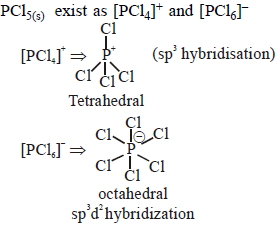
The structure of $PCl _{5}$ in the solid state is
  • A
    square pyramidal
  • tetrahedral $\left[ PCl _{4}\right]^{+}$ and octahedral $\left[ PCl _{6}\right]^{-}$
  • C
    square planar $\left[ PCl _{4}\right]^{+}$ and octahedral $\left[ PCl _{6}\right]^{-}$
  • D
    trigonal bipyramidal

Answer

Correct option: B.
tetrahedral $\left[ PCl _{4}\right]^{+}$ and octahedral $\left[ PCl _{6}\right]^{-}$
b

Need a full question paper?

Generate a complete, print-ready paper with questions like this in minutes — across 16+ boards, with answer keys.

Start Generating Free

Similar questions

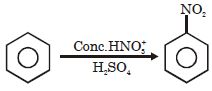
In nitration of benzene conc. $HNO_3$ act as
The correct order of the number of unpaired electrons in the given complexes is

$A.$ $\left[ Fe ( CN )_6\right]^{3-}$;$B.$ $\left[ FeF _6\right]^{3-}$; $C.$ $\left[ CoF _6\right]^{3-}$; $D.$ $\left[ Cr (\text { oxalate })_3\right]^{3-}$; $E.$ $\left[ Ni ( CO )_4\right]$

Choose the correct answer from the options given below:

If an atom has electronic configuration $1{s^2}2{s^2}2{p^6}3{s^2}3{p^6}3{d^3}4{s^2},$ it will be placed in
Given below are two statements : one is labelled as Assertion $A$ and the other is labelled as Reason $R$ :

Assertion $A$ : Aryl halides cannot be prepared by replacement of hydroxyl group of phenol by halogen atom.

Reason $R$ : Phenols react with halogen acids violently. In the light of the above statements, choose the most appropriate from the options given below:

In the complete combustion of $C_4H_{10}$ the number of oxygen moles required is
The value of $\frac{{{t_{0.875}}}}{{{t_{0.50}}}}$ for $n^{th}$ order reaction is
Order of a reaction can have
The required charge for one equivalent weight of silver deposite on cathode is
The formation of a chemical bond is accompanied by
The ground state electronic configurations of the elements, $U, V, W, X,$ and $Y$ (these symbols do not have any chemical significance) are as follows

$U\,\,\, 1s^2 \,2s^2 \,2p^3$
$V\,\,\, 1s^2\,2s^2 \,2p^6 \,3s^1$
$W\,\,\, 1s^2\,2s^2\, 2p^6\,3s^2\,3p^2$
$X\,\,\, 1s^2\,2s^2\,2p^6\,3s^2\,3p^6\,3d^5\, 4s^2$
$Y\,\,\, 1s^2\, 2s^2\,2p^6\,3s^2\,3p^6\,3d^{10}\, 4s^2\, 4p^6$

Determine which sequence of elements satisfy the following statements :
$(i)$ Element forms a carbonate which is not decomposed by heating
$(ii)$ Element is most likely to form coloured ionic compounds
$(iii)$ Element has largest atomic radius
$(iv)$ Element forms only acidic oxide