MCQ
The structure of $P{F_5}$molecule is
  • A
    Tetrahedral
  • Trigonal bipyramidal
  • C
    Square planar
  • D
    Pentagonal bipyramidal

Answer

Correct option: B.
Trigonal bipyramidal
(b)$P{F_5}$ involves $s{p^3}d$ hybridization and hence has trigonal bipyramidal structure.

Need a full question paper?

Generate a complete, print-ready paper with questions like this in minutes — across 16+ boards, with answer keys.

Start Generating Free

Similar questions

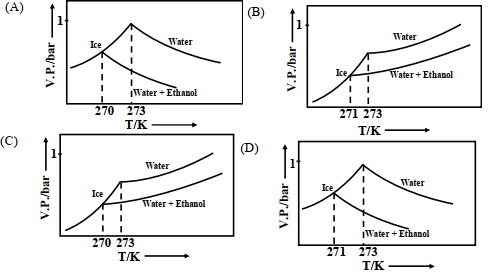
Pure water freezes at $273 \mathrm{~K}$ and $1$ bar. The addition of $34.5 \mathrm{~g}$ of ethanol to $500 \mathrm{~g}$ of water changes the freezing point of the solution. Use the freezing point depression constant of water as $2 \mathrm{~K} \mathrm{~kg} \mathrm{~mol}^{-1}$. The figures shown below represent plots of vapour pressure ($V.P$.) versus temperature ($T$). [molecular weight of ethanol is $46 \mathrm{~g} \mathrm{~mol}^{-1}$ ]

Among the following, the option representing change the freezing point is

(IMAGE)
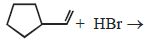
The absolute value of the electron gain enthalpy of halogens satisfies
In which of the following reactions aromatic aldehyde is treated with acid anhydride in presence of corresponding salt of the acid to give unsaturated aromatic acid
Which of the following product is not formed in the following reaction
$BF_3$ on hydrolysis forms
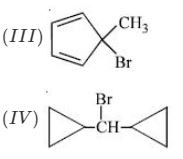
Arrange the following compounds in decreasing order of their reactivity for hydrolysis reaction

$(I)$ $C_6H_5-CH-Br$

$(II)$ $\begin{array}{*{20}{c}}
  {{C_6}{H_5} - CH - {C_2}{H_5}} \\ 
  {|\,\,\,} \\ 
  {Br} 
\end{array}$
Which of the following is a disaccharide
For a certain reaction at $300 \mathrm{~K}, \mathrm{~K}=10$, then $\Delta \mathrm{G}^{\circ}$ for the same reaction is _____________$\times 10^{-1} \mathrm{~kJ} \mathrm{~mol}^{-1}$. (Given $\mathrm{R}=8.314 \mathrm{JK}^{-1} \mathrm{~mol}^{-1}$ )
Which of the following is the strongest base ?
Assertion : Cuprous ion $(Cu^+)$ has unpaired electrons while cupric ion $(Cu^{++})$ does not.
Reason : Cuprous ion $(Cu^+)$ is colourless whereas cupric ion $(Cu^{++})$ is blue in the aqueous solution.