MCQ
The substances having very short plastic region are
  • A
    Ductile
  • Brittle
  • C
    Malleable
  • D
    All of these

Answer

Correct option: B.
Brittle
b
(b)

Substances with short plastic region are brittle because less amount of permanent deformation could be done in them.

Need a full question paper?

Generate a complete, print-ready paper with questions like this in minutes — across 16+ boards, with answer keys.
Start Generating Free

Similar questions

If the resistance of a conductor is $5\,\Omega\,\,$ at $\,50\,^oC$ and $7\, \Omega\,$ at $\,100\,^oC$ then the mean temperature coefficient of resistance of the material is ............... $^oC$
The amplification factor of a triode valve is $15$. If the grid voltage is changed by $0.3 \,volt$  the change in plate voltage in order to keep the plate current constant (in volt) is
In a stationary wave all the particles
In a photoelectric effect experiment a light of frequency 1.5 times the threshold frequency is made to fall on the surface of photosensitive material. Now if the frequency is halved and intensity is doubled, the number of photo electrons emitted will be:
The electrical resistance of depletion layer is large because
A reversible engine and an irreversible engine are working between the same temperatures. The efficiency of the ...........
Two small equal point charges of magnitude $q$ are suspended from a common point on the ceiling by insulating mass less strings of equal lengths. They come to equilibrium with each string making angle $\theta $ from the vertical. If the mass of each charge is $m,$ then the electrostatic potential at the centre of line joining them will be $\left( {\frac{1}{{4\pi { \in _0}}} = k} \right).$
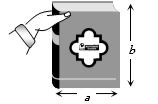
A person supports a book between his finger and thumb as shown (the point of grip is assumed to be at the corner of the book). If the book has a weight of $W$ then the person is producing a torque on the book of 
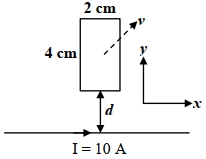
A rectangular conducting loop of length $4 \mathrm{~cm}$ and width $2 \mathrm{~cm}$ is in the $x y$-plane, as shown in the figure. It is being moved away from a thin and long conducting wire along the direction $\frac{\sqrt{3}}{2} \hat{x}+\frac{1}{2} \hat{y}$ with a constant speed $v$. The wire is carrying a steady current $\mathrm{I}=10 \mathrm{~A}$ in the positive $x$-direction. A current of $10 \mu \mathrm{A}$ flows through the loop when it is at a distance $d=4 \mathrm{~cm}$ from the wire. If the resistance of the loop is $0.1 \Omega$, then the value of $v$ is. . . . . . .$\mathrm{ms}^{-1}$.

[Given: The permeability of free space $\mu_0=4 \pi \times 10^{-7} \mathrm{NA}^{-2}$ ]
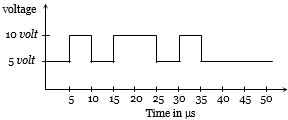
In a negative logic the following wave form corresponds to the