Question
The sum of three consecutive odd numbers is $21$. Find the numbers.

Answer

Let the required numbers are $x, x + 2$ and $x + 4$
Then, $x + x + 2 + x + 4 = 21$
Or, $3x = 21 - 6$
$\Rightarrow\text{x}=\frac{15}{3}$
$x = 5$
So, the numbers are $5, (5 + 2 ) = 7$ and $(5 + 4) = 9$

Need a full question paper?

Generate a complete, print-ready paper with questions like this in minutes — across 16+ boards, with answer keys.

Start Generating Free

Similar questions

By looking at the number line, answer the question:
Which integers lie between $– 8$ and $– 2?$ Which is the largest integer and the smallest integer among them?
Divide, and find out the quotient and remainder. Check your answer. $23025 ÷ 1000$
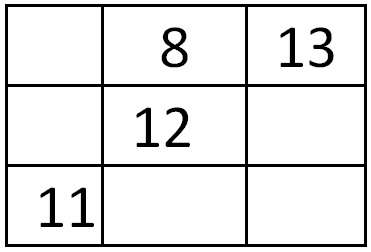
A magic square is an array of numbers having the same number of rows and columns and the sum of numbers in each row, column or diagonal being the same. Fill in the blank cells of the following magic square:
Telegraph poles occur at equal distances of $220 m$ along a road and heaps of stones are put at equal distances of $300 m$ along the same road. The first heap is at the foot of the first pole. How far from it along the road is the next heap which lies at the foot of a pole?
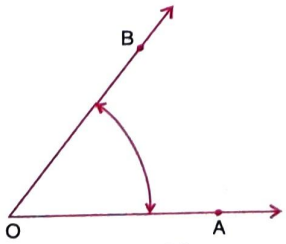
Measure $\angle A O B$ given in Fig. and construct an angle $\angle P Q R$ equal to $\angle A O B$.
Image
Simplify: $1\frac{5}{6}+\Big[2\frac{2}{3}-\Big\{3\frac{3}{4}\Big(3\frac{4}{5}\div9\frac{1}{2}\Big)\Big\}\Big]$
Prepare a frequency table of the following ages (in years) of $30$ students of class $VIII$ in your school: $13, 14, 13, 12, 14, 13, 14, 15, 13, 14,$ $13, 14, 16, 12, 14 13, 14, 15, 16, 13, 14, 13, 12, 17, 13, 12, 13, 13, 13, 14$
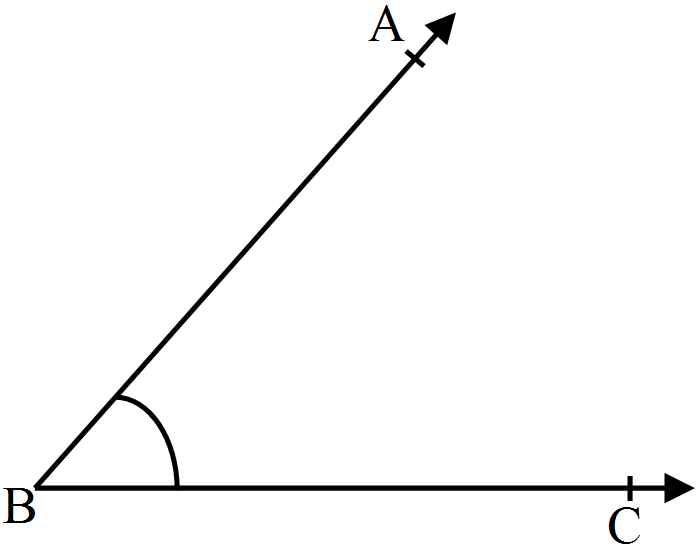
Measure $\angle\text{ABC}$ given in the adjoining figure and construct an angle DEF equal to $\angle\text{ABC}.$
A tea merchant blends two varieties of tea costing her $Rs. 234$ and $Rs. 130$ per $kg$ in the ratio of their costs. If the weight of the mixture is $84\ kg$, then find the weight of each variety of tea.
If $AB = 7.5\ cm$ and $CD = 2.5\ cm$, construct a segment whose length is equal to: $AB + CD$